











Agentic AI Overview: Use Cases in Web Automation and CAPTCHA Solving

Aloísio Vítor
How to use CapSolver
23-Apr-2026
TL;Dr
- Agentic AI represents a paradigm shift from passive, prompt-driven models to autonomous systems capable of multi-step reasoning, tool use, and independent goal execution.
- The global agentic AI market is projected to grow from 7.29 billion in 2025 to 139.19 billion by 2034, driven by enterprise adoption across industries.
- Web automation is one of the most impactful agentic ai use cases, enabling dynamic, adaptive data extraction that traditional scripts cannot achieve.
- Modern CAPTCHAs remain a persistent obstacle for AI agents due to precision gaps, cognitive limitations, and behavioral detection mechanisms.
- Integrating a specialized service like CapSolver into your agentic workflow ensures compliant, high-accuracy CAPTCHA resolution without disrupting your automation pipeline.
Introduction
The landscape of artificial intelligence is undergoing a profound transformation. We are moving beyond systems that simply answer questions to systems that take action. This shift is driven by agentic AI, a technology designed to execute complex, multi-step goals autonomously. For developers and enterprises, understanding the agentic ai overview is no longer optional; it is a necessity for staying competitive. This article provides a deep dive into the definition, working principles, and practical agentic ai use cases, with a specific focus on web automation. We will also explore the persistent challenge of CAPTCHA solving in these automated workflows, and how specialized solutions can ensure your AI agents operate efficiently and compliantly.
What Is Agentic AI? A Comprehensive Overview
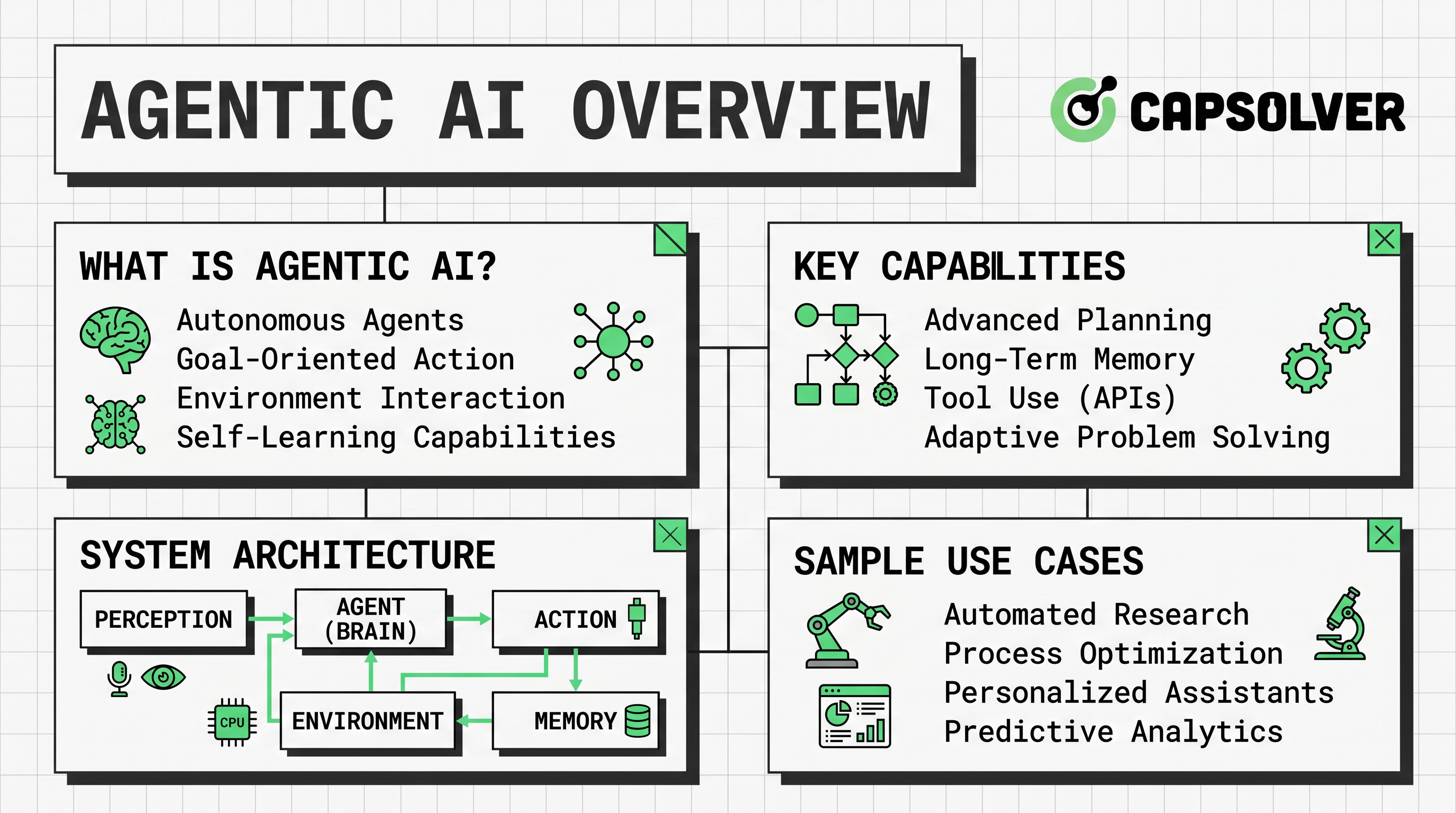
To fully grasp the agentic ai overview, we must first define what sets it apart from traditional AI models. Agentic AI refers to autonomous software systems that perceive their environment, reason through complex problems, and take independent actions to achieve predefined goals. According to MIT Sloan, these agents enhance large language models by enabling them to automate complex procedures, use external tools, and interact with digital environments to function as powerful components within larger workflows.
The term "agentic" is derived from the concept of agency — the capacity to act independently. Unlike a standard chatbot that responds to a single prompt, an agentic AI system can receive a high-level objective, decompose it into smaller tasks, execute those tasks using various tools, and adjust its strategy based on real-time feedback. This makes the agentic ai overview fundamentally different from anything that came before in the AI space.
The Core Mechanisms of Agentic AI
The functionality of agentic AI relies on four interconnected components that work in concert:
- Perception: The ability to gather data from digital environments — reading web pages, accessing APIs, or monitoring system logs — to understand the current state of the world.
- Reasoning: Utilizing Large Language Models (LLMs) to break down high-level goals into actionable sub-tasks, evaluate options, and make context-aware decisions at each step.
- Action: Executing tasks through tool use, such as clicking buttons on a website, sending emails, writing and running code, or querying databases.
- Memory: Maintaining state and context across multiple interactions, allowing the agent to learn from past actions and adapt its strategy without losing track of the overall goal.
Agentic AI vs. Traditional AI: A Comparison Summary
Understanding the distinction between these two paradigms is crucial for identifying the right agentic ai use cases for your organization. The table below summarizes the key differences:
| Feature | Traditional AI (e.g., standard LLMs) | Agentic AI |
|---|---|---|
| Execution Style | Reactive (Prompt-driven) | Proactive (Goal-driven) |
| Task Complexity | Single-step, isolated tasks | Multi-step, complex workflows |
| Tool Integration | Limited or non-existent | Extensive (APIs, browsers, databases) |
| Adaptability | Static responses based on training data | Dynamic adjustments based on real-time feedback |
| Human Oversight | Required at each step | Minimal; operates autonomously |
| Primary Use Case | Content generation, basic Q&A | Autonomous web automation, complex problem solving |
Key Agentic AI Use Cases in the Modern Enterprise
The global agentic AI market is experiencing explosive growth. Research from Fortune Business Insights projects the market size to grow from 7.29 billion in 2025 to 139.19 billion by 2034, at a CAGR of 40.5%. A separate survey by Kong Inc. found that 90% of enterprises are actively adopting AI agents, with 79% expecting full-scale deployment within three years. This rapid adoption is driven by diverse agentic ai use cases across virtually every industry.
1. Advanced Web Automation and Data Extraction
One of the most prominent agentic ai use cases is in web automation. Traditional web scraping relies on rigid scripts that break when a website's layout changes. Agentic AI, however, can visually parse a webpage, identify the necessary elements, and adapt to structural changes on the fly. This capability is invaluable for market research, competitor analysis, and dynamic pricing models. An agentic AI system can navigate paginated results, handle login flows, and extract structured data from complex JavaScript-rendered pages — tasks that would require constant maintenance with conventional tools.
2. Autonomous Customer Support
Agentic AI systems can handle complex customer service inquiries that require accessing multiple backend systems. For example, an agent could autonomously verify a user's identity, check their order status in a database, process a refund through a payment gateway, and send a confirmation email — all without human intervention. This represents a significant evolution beyond simple chatbots, as the agent can reason through edge cases and take decisive action.
3. Cybersecurity Incident Response
In the realm of cybersecurity, agentic AI can automate the classification, tracking, and resolution of security incidents. When a threat is detected, the agent can isolate the affected system, gather forensic data, and apply predefined remediation protocols, significantly reducing response times. This agentic ai use case is particularly valuable given the speed at which modern cyberattacks propagate.
4. Research and Knowledge Synthesis
Agentic AI can autonomously browse the web, read academic papers, cross-reference data from multiple sources, and produce comprehensive research reports. This dramatically accelerates knowledge work that would otherwise require hours of manual effort, making it one of the most intellectually impactful agentic ai use cases available today.
The CAPTCHA Challenge in Agentic Web Automation
While the agentic ai overview paints a picture of highly capable systems, practical implementation in web automation consistently hits a significant roadblock: CAPTCHAs. These security measures are specifically designed to differentiate between human users and automated systems. For any agentic workflow that involves web interaction, understanding and addressing CAPTCHAs is a non-negotiable requirement.
Why Agentic AI Struggles with CAPTCHAs
Despite their advanced reasoning capabilities, AI agents face several distinct technical hurdles when encountering CAPTCHAs:
- The Precision Problem: Many CAPTCHAs, such as slider puzzles or image selection grids, require fine-grained spatial control and pixel-perfect accuracy. Multimodal AI models often lack this level of motor control in virtual environments, leading to repeated failures on tasks that a human would complete in seconds.
- The Cognitive Gap: Humans use intuition to quickly recognize patterns in distorted text or ambiguous images. AI agents, relying on brittle step-by-step reasoning, often over-analyze or misinterpret these visual cues. Research highlighted by MBZUAI shows that while humans achieve over 93% accuracy on modern CAPTCHA puzzles, AI agents often hover around 40%.
- Behavioral Detection: Modern CAPTCHAs (like reCAPTCHA v3 or Cloudflare Turnstile) analyze user behavior — mouse movements, interaction timing, and browsing history — rather than presenting a visual puzzle. AI agents often exhibit "strategy drift" or robotic interaction patterns that trigger these behavioral flags before they even reach the challenge.
- Economic Infeasibility: Running high-compute vision models for every single CAPTCHA interaction is financially unsustainable for most production-scale automation pipelines.
Types of CAPTCHAs Encountered in Automation
Understanding the specific types of challenges is essential for developing robust agentic ai use cases in web automation. Each type presents a unique set of difficulties for automated systems:
- Image Recognition CAPTCHAs: Selecting specific objects (e.g., traffic lights, crosswalks, bicycles) from a grid of images. These require accurate object detection in ambiguous, low-resolution contexts.
- Slider and Puzzle CAPTCHAs: Dragging a puzzle piece to a precise location, requiring fine-grained coordinate control and realistic movement trajectories.
- Invisible and Behavioral CAPTCHAs: Running entirely in the background to assess user interaction patterns and assign a risk score. There is no visual component for the agent to interact with.
- Text-based CAPTCHAs: Identifying distorted, overlapping, or obscured alphanumeric characters — a challenge that has become increasingly difficult even for modern OCR systems.
Redeem Your CapSolver Bonus Code
Boost your automation budget instantly!
Use bonus code CAP26 when topping up your CapSolver account to get an extra 5% bonus on every recharge — with no limits.
Redeem it now in your CapSolver Dashboard
Bridging the Gap: Integrating CapSolver into Agentic Workflows
To fully realize the potential of agentic ai use cases in web automation, developers must address the CAPTCHA bottleneck directly. Relying solely on the AI agent's internal vision models is often inefficient and leads to high failure rates. The most effective and compliant strategy is to integrate a specialized solving service into the agentic workflow.
This is where CapSolver becomes an indispensable component of your architecture. CapSolver provides a robust API that handles the complexities of CAPTCHA solving, allowing your AI agents to focus on their core reasoning and data extraction tasks. By offloading this specific challenge to a dedicated system, you ensure that your automated pipelines remain fluid and uninterrupted. You can also explore CapSolver's dedicated resources on web scraping automation and reCAPTCHA solving strategies for deeper technical guidance.
How CapSolver Enhances Agentic AI Pipelines
Integrating CapSolver into your agentic AI architecture offers several key advantages that directly address the challenges outlined above:
- High Accuracy and Speed: CapSolver utilizes advanced machine learning algorithms specifically trained for CAPTCHA recognition, ensuring high success rates and low latency across all major challenge types.
- Support for Diverse CAPTCHA Types: Whether your agent encounters Cloudflare Turnstile, reCAPTCHA v2/v3, or complex image puzzles, CapSolver provides a unified API solution.
- Compliance and Reliability: CapSolver emphasizes ethical and compliant automation practices, helping you maintain stable data pipelines while respecting the intent of security measures.
- Scalability: The API-first design allows your agentic AI system to handle CAPTCHA challenges at scale, from a handful of requests to millions per day.
Code Example: Solving reCAPTCHA v2 in an Agentic Workflow
The following Python example, based on the CapSolver official documentation, demonstrates how an AI agent can delegate the CAPTCHA solving process and retrieve the necessary token to proceed with its workflow. This is a direct implementation from the official API reference.
python
# pip install requests
import requests
import time

# TODO: set your config
api_key = "YOUR_API_KEY"  # your api key of capsolver
site_key = "6Le-wvkSAAAAAPBMRTvw0Q4Muexq9bi0DJwx_mJ-"  # site key of your target site
site_url = "https://www.google.com/recaptcha/api2/demo"  # page url of your target site


def capsolver():
    payload = {
        "clientKey": api_key,
        "task": {
            "type": 'ReCaptchaV2TaskProxyLess',
            "websiteKey": site_key,
            "websiteURL": site_url
        }
    }
    res = requests.post("https://api.capsolver.com/createTask", json=payload)
    resp = res.json()
    task_id = resp.get("taskId")
    if not task_id:
        print("Failed to create task:", res.text)
        return
    print(f"Got taskId: {task_id} / Getting result...")

    while True:
        time.sleep(1)  # delay
        payload = {"clientKey": api_key, "taskId": task_id}
        res = requests.post("https://api.capsolver.com/getTaskResult", json=payload)
        resp = res.json()
        status = resp.get("status")
        if status == "ready":
            return resp.get("solution", {}).get('gRecaptchaResponse')
        if status == "failed" or resp.get("errorId"):
            print("Solve failed! response:", res.text)
            return


token = capsolver()
print(token)
By utilizing this approach, your agentic AI systems can navigate complex web environments without being halted by security friction. The agent simply calls the CapSolver API, waits for the token, and injects it into the form submission — a clean, modular integration that keeps your core agentic logic uncluttered. For those building more complex pipelines, CapSolver also provides guidance on identifying and extracting CAPTCHA parameters automatically.
Conclusion
The transition from traditional AI to agentic AI marks a significant leap in technological capability. As outlined in this agentic ai overview, the ability of these systems to reason, plan, and execute multi-step tasks autonomously is opening up unprecedented agentic ai use cases, particularly in web automation. However, the reality of the modern web includes sophisticated security measures like CAPTCHAs that challenge even the most advanced AI agents due to precision gaps and behavioral detection.
To build truly resilient and scalable automated workflows, developers must recognize the limitations of general-purpose AI in handling fine-grained, stateful interactions. By integrating specialized services like CapSolver, you can bridge the gap between cognitive reasoning and practical execution. This ensures that your agentic AI systems remain efficient, compliant, and capable of delivering on their full potential for autonomous productivity.
FAQ
1. What is the main difference between generative AI and agentic AI?
Generative AI primarily focuses on creating content — text, images, or code — based on a user prompt in a single interaction. Agentic AI is goal-driven; it can autonomously plan, use tools, and execute multi-step actions over an extended period to achieve a specific objective without constant human intervention.
2. Why do advanced AI agents fail at solving CAPTCHAs?
AI agents often fail at CAPTCHAs because they lack the fine-grained spatial precision and human-like intuition required for visual puzzles. Furthermore, their interaction patterns can appear robotic, triggering behavioral detection mechanisms in modern CAPTCHA systems like reCAPTCHA v3 and Cloudflare Turnstile.
3. How does CapSolver improve agentic web automation?
CapSolver provides a dedicated API to handle complex CAPTCHA challenges. By offloading this task to a specialized service, AI agents can navigate security friction efficiently and compliantly, allowing them to focus on their primary goals like data extraction or workflow automation.
4. Are agentic AI use cases limited to web automation?
No. While web automation is a prominent use case, agentic AI is also being deployed in cybersecurity incident response, autonomous customer support, complex data analysis, financial trading, and even physical robotics and warehouse management.
5. Is it compliant to use CAPTCHA solving services in automated workflows?
Yes, when used responsibly and for legitimate purposes. Services like CapSolver emphasize ethical automation and compliance. It is important to ensure that your automated activities align with the terms of service of the target websites and respect applicable data privacy regulations.
Compliance Disclaimer: The information provided on this blog is for informational purposes only. CapSolver is committed to compliance with all applicable laws and regulations. The use of the CapSolver network for illegal, fraudulent, or abusive activities is strictly prohibited and will be investigated. Our captcha-solving solutions enhance user experience while ensuring 100% compliance in helping solve captcha difficulties during public data crawling. We encourage responsible use of our services. For more information, please visit our Terms of Service and Privacy Policy.
More
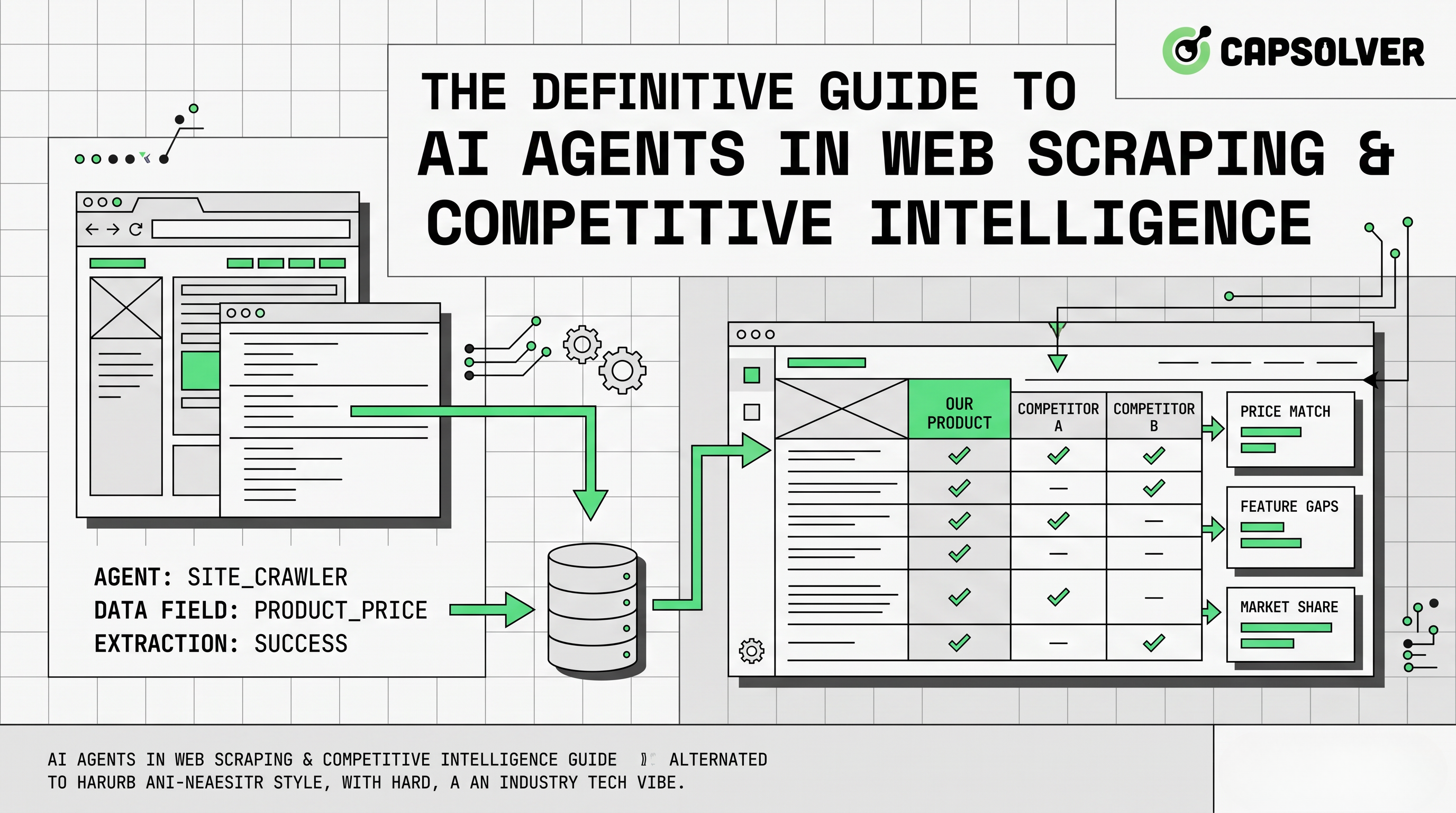
AI Agents in Web Scraping & Competitive Intelligence Guide
Discover how AI agents transform web scraping and competitive intelligence. Learn about automated data collection, anti-bot challenges, and CAPTCHA solutions for scalable workflows.

Sora Fujimoto
28-Apr-2026
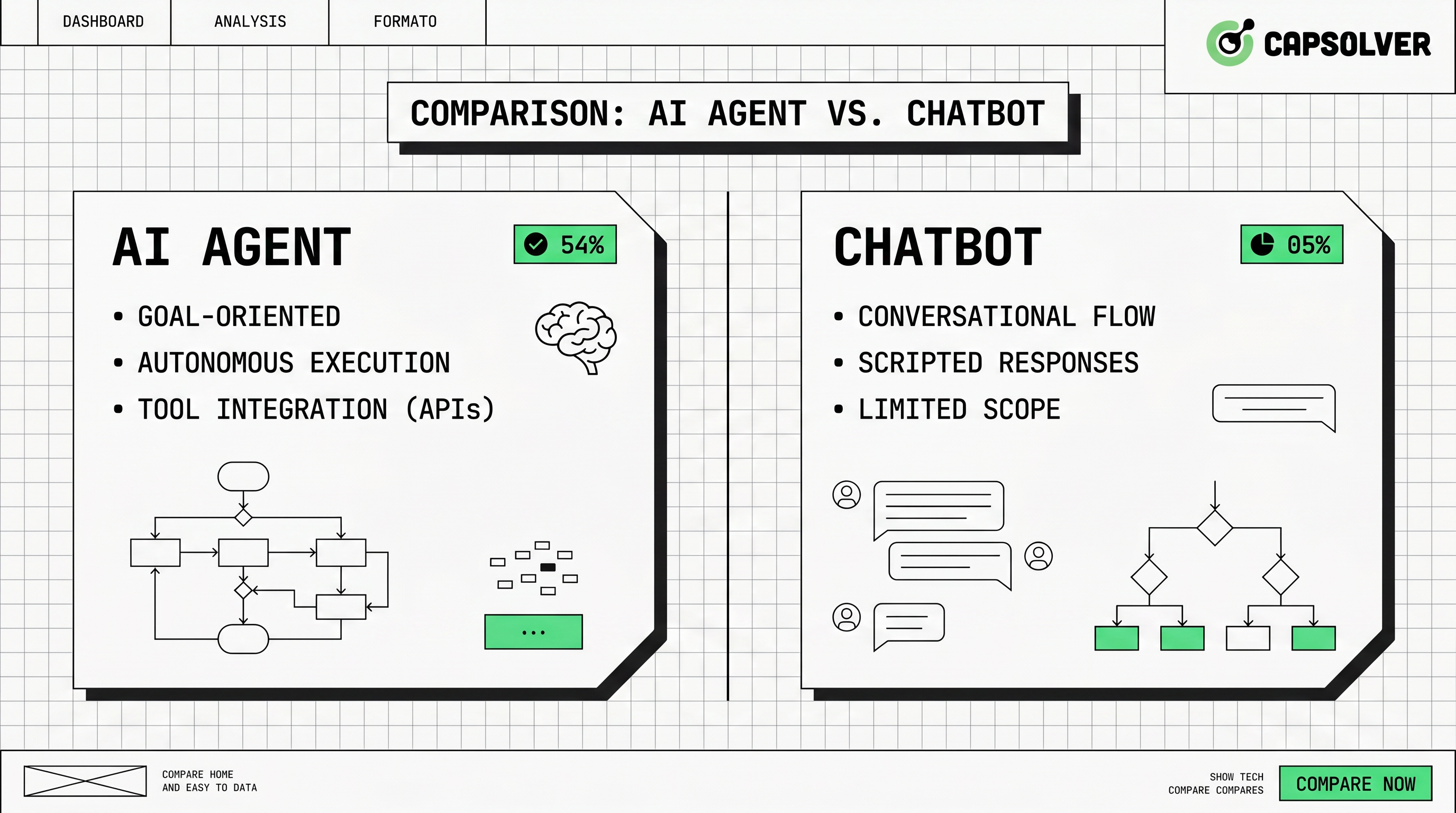
AI Agent vs Chatbot: Key Differences in Automation Capabilities
Discover the key differences between AI agent vs chatbot. Learn how agentic AI outperforms traditional AI in automation, decision-making, and complex workflows.

Emma Foster
24-Apr-2026
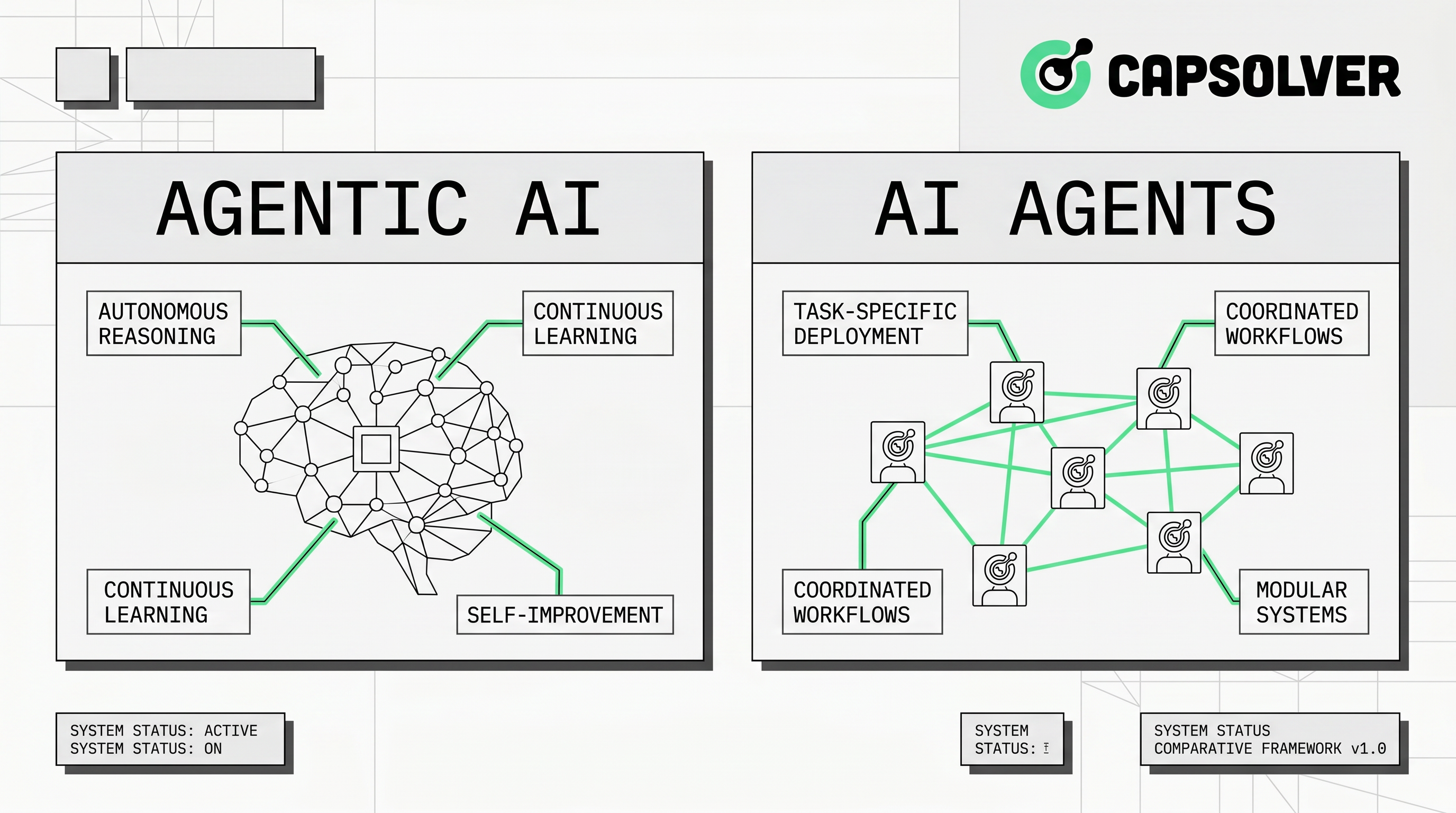
Agentic AI vs AI Agents: Key Differences for Automation Engineers
Discover the key differences between Agentic AI and AI Agents. Learn how automation engineers can build scalable workflows and solve CAPTCHAs efficiently.

Nikolai Smirnov
24-Apr-2026
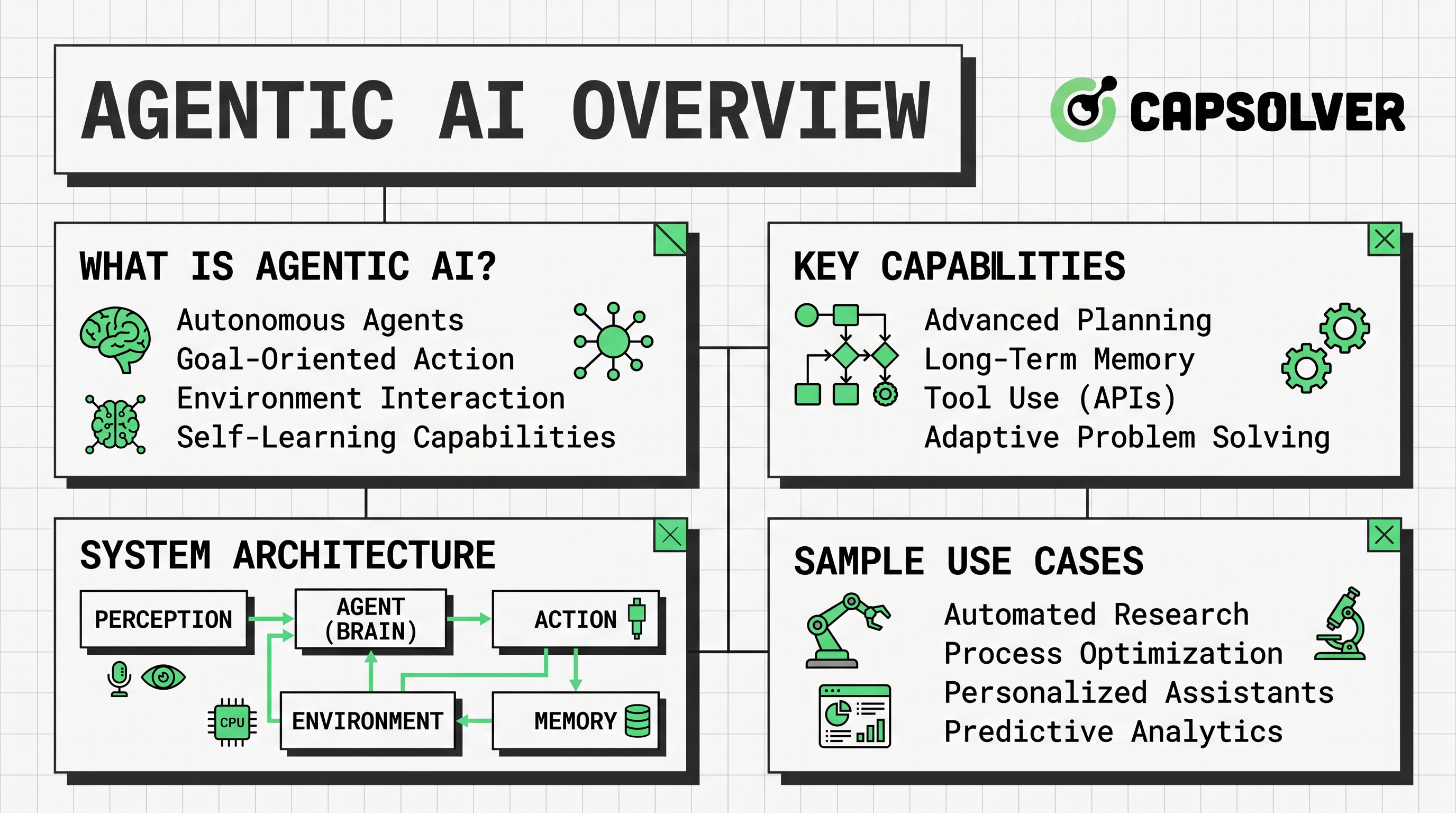
Agentic AI Overview: Use Cases in Web Automation and CAPTCHA Solving
Explore a full agentic AI overview: how it works, key use cases in web automation, and how to solve CAPTCHA challenges in agentic pipelines with CapSolver.
Aloísio Vítor
23-Apr-2026
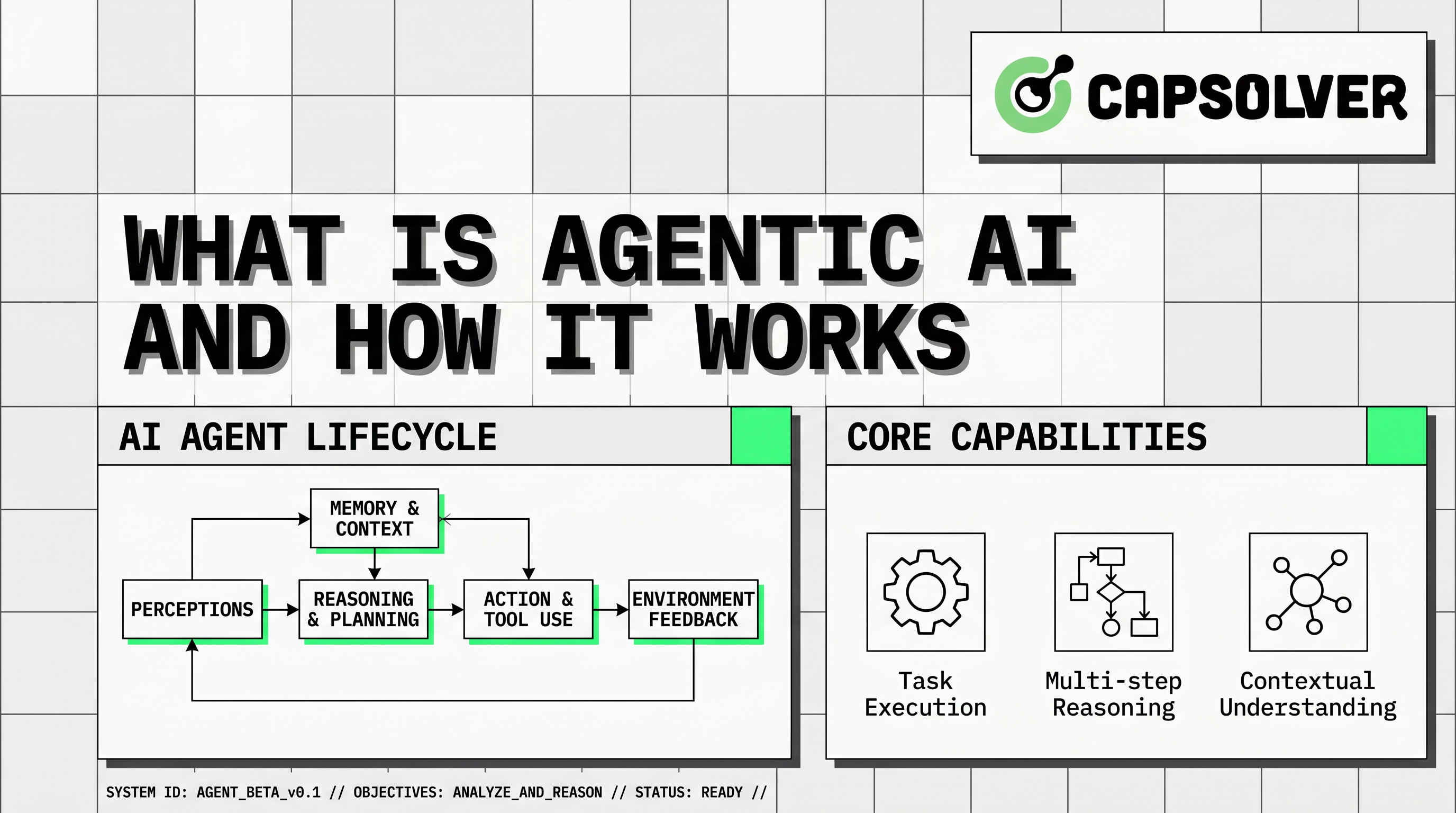
What Is Agentic AI and How It Works in Automated Web Interaction
Discover what agentic AI is, how it works, and its role in automated web interaction. Learn about AI agents, CAPTCHA solving, and how CapSolver streamlines automation.

Lucas Mitchell
23-Apr-2026
Best AI for Solving Image Puzzles: Top Tools and Strategies for 2026
Discover the best AI for solving image puzzles. Learn how CapSolver's Vision Engine and ImageToText APIs automate complex visual challenges with high accuracy.

Ethan Collins
22-Apr-2026