




How to Fix CAPTCHA MCP Calls Using the Wrong Browser Session

Khadija Santos
How to use CapSolver
28-Oct-2026
TL;DR
- A CAPTCHA MCP tool that accepts a URL does not automatically operate on the browser tab your agent already controls.
- In the tested
capsolver-mcp0.1.3 interface,detect_captchasandsolve_on_pageacceptpage_url; neither exposes an existing-page or browser-session input. - Inspect the advertised tool schema before assuming that two MCP servers share a browser.
- Keep the original page under its existing browser owner. Use an integration that accepts that page, or route documented parameters and results through your own application.
- Confirm the original application task after handling a supported challenge. A tool response alone does not confirm that a form submitted or a data lookup completed.
Your browser agent has filled a form and reached a CAPTCHA. It calls a second MCP tool with the page URL, receives a response, and returns to a tab that still looks unchanged. The missing connection may be the browser session itself.
MCP makes a tool callable; it does not make every connected server share live browser objects. The browser that prepared the form and the browser opened by a URL tool can be separate. CapSolver provides both MCP tools and a Python Core SDK, so choosing the right interface matters when a CAPTCHA appears halfway through an existing task.
This guide diagnoses that specific handoff. It includes a real MCP schema check and observations from an owned local browser fixture. No paid challenge was solved, and no production form acceptance is claimed.
Why does the CAPTCHA MCP call use another browser?
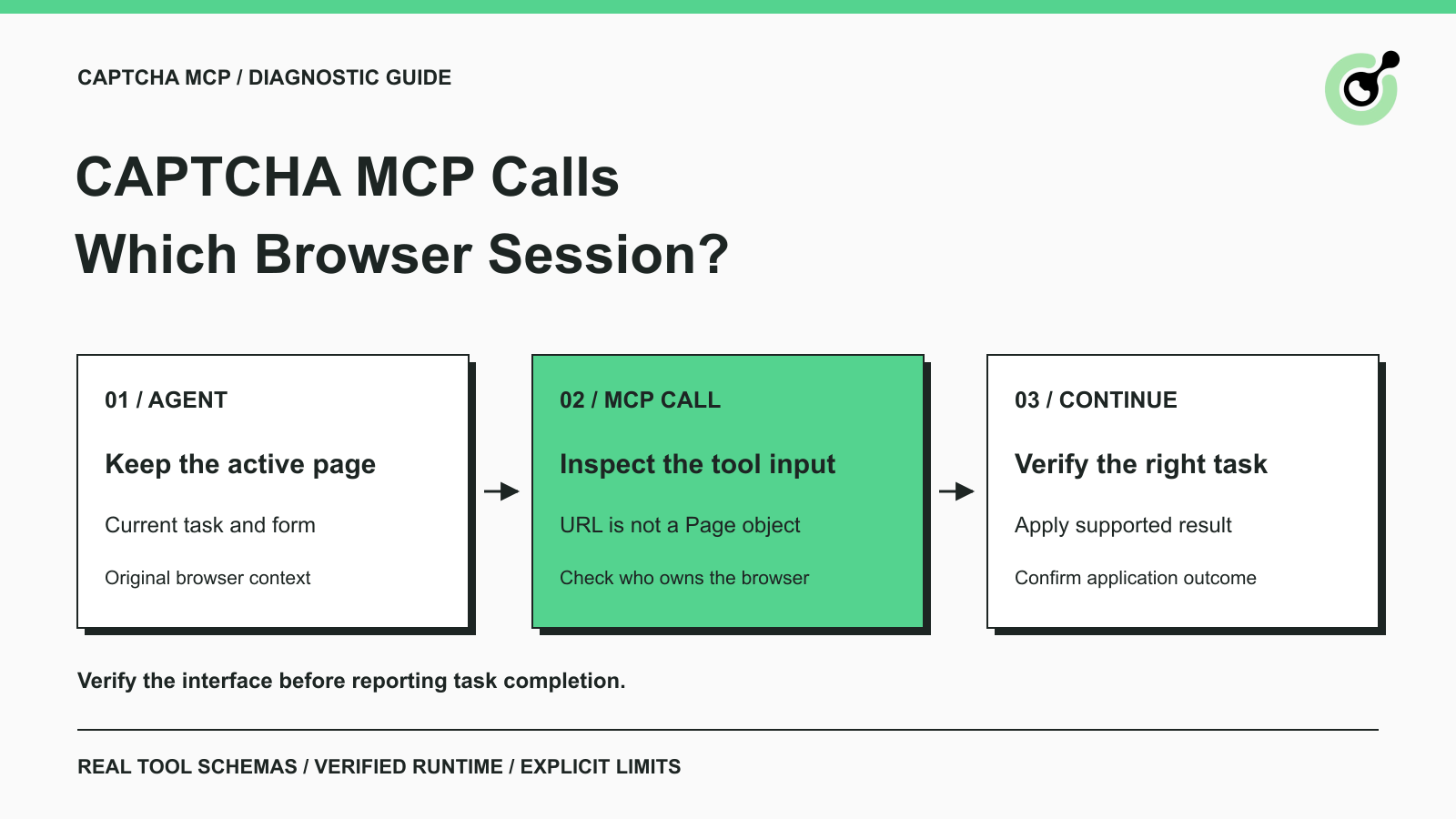
The tested MCP browser tools create their own browser from a URL rather than receiving the agent's active page.
The MCP service reference describes URL-based detection and page solving. We checked the installed package's advertised schemas and browser-launch implementation, then observed its requests to a local fixture. Those checks agree on the boundary: supplying the URL does not attach the tool to an already running tab.
That distinction matters even when both pages display the same address. A form field can contain an unsent value in one tab and be empty in another. A cookie available to one browser context does not automatically appear in an unrelated context. Playwright's browser-context guidance explains the isolation between contexts.
Do not infer shared state from the two tool servers appearing in the same assistant sidebar. Their tools may be available to the same model while their browser processes remain independent.
Inspect the tool schema before changing the workflow
Inspect the live schema to identify which state the tool can actually receive.
Use Python 3.12 for the reproducible check below. The tested environment contained capsolver-mcp 0.1.3, capsolver-core 0.1.1, MCP Python SDK 1.30.0, and Playwright 1.64.1. The official MCP repository identifies the server package; the MCP Python SDK supplies the client used for this diagnostic.
Run these commands with the Python interpreter that will launch the server:
bash
python -m pip install "capsolver-mcp[browser]==0.1.3" "capsolver-core==0.1.1" "mcp==1.30.0" "playwright==1.64.1"
python -m playwright install chromium
Save this small diagnostic as inspect_mcp.py and run it with that same Python. It initializes a real stdio connection, reads the schemas, and calls the supported-types registry. It deliberately passes an empty API-key value and never calls solving or balance methods. A real paid solve requires a valid key and an authorized target; this diagnostic does not test that path.
python
import asyncio
import json
import sys
from mcp import ClientSession, StdioServerParameters
from mcp.client.stdio import stdio_client

async def main():
    server = StdioServerParameters(
        command=sys.executable,
        args=["-m", "capsolver_mcp"],
        env={"CAPSOLVER_API_KEY": ""},
    )
    async with stdio_client(server) as (read, write):
        async with ClientSession(read, write) as session:
            await session.initialize()
            result = await session.list_tools()
            for tool in result.tools:
                if tool.name in {"detect_captchas", "solve_on_page"}:
                    print(json.dumps({
                        "tool": tool.name,
                        "arguments": sorted(tool.inputSchema.get("properties", {})),
                        "required": tool.inputSchema.get("required", []),
                    }))
            registry = await session.call_tool("get_supported_captchas", {})
            print("registry_is_error:", bool(registry.isError))

asyncio.run(main())
For the tested version, the meaningful output was:
text
{"tool": "detect_captchas", "arguments": ["page_url"], "required": ["page_url"]}
{"tool": "solve_on_page", "arguments": ["autofill", "page_url", "polling_interval", "timeout"], "required": ["page_url"]}
registry_is_error: False
The absence of a session argument is a reason to inspect the implementation, not a universal claim about every MCP server. Here, package inspection confirmed a new headless browser and page for each URL-based browser call. Recheck the schema and behavior when changing versions.
What the local browser test showed
The local test demonstrated a session boundary without pretending to solve a CAPTCHA.
We opened an owned HTTP fixture in a Playwright context, set a harmless fixture_session cookie, and entered a catalog query into a text field. The fixture logged whether each request carried that cookie. We then called the real MCP detect_captchas tool with the same URL.
The original browser's request included the marker cookie. The MCP browser's request did not. The original page still contained the entered query after the tool returned. Detection returned an empty list on this inert fixture; it was not a live provider challenge and the test does not measure detection coverage.
These observations establish something narrower and useful: the MCP call fetched the URL independently, while the first page stayed intact. They do not establish paid solving, token transfer, or acceptance by a target site. No production cookies, credentials, or private records were used.
For your application, reproduce the same distinction with a harmless marker on a staging page you control. Record which page the browser tool owns and which page the solver receives. Avoid recording real cookie contents or CAPTCHA tokens in diagnostic logs.
Redeem Your CapSolver Bonus Code
Boost your automation budget instantly!
Use bonus code CAP26 when topping up your CapSolver account to get an extra 5% bonus on every recharge — with no limits.
Redeem it now in your CapSolver Dashboard

Choose a handoff that matches your browser owner
Choose the handoff according to whether your application can access the active page object.
Your Python application owns the Playwright page
The Core SDK accepts an existing Playwright page for browser-oriented methods. The documented detect(page) and get_captcha_info(page) methods inspect that page; solve_on_page(page) performs the documented solving and fill-back sequence for supported challenges. The Core SDK reference describes these interfaces and their result fields.
Keep the page in your own application and pass the existing object at the CAPTCHA checkpoint. Creating a new page inside the handler changes the operation you are diagnosing. This is an implementation choice for applications that own their browser code, not a configuration flag that makes the URL-only MCP tool attach to a tab.
This guide verifies the MCP boundary, not a paid Core SDK solve. Before adopting a page-based solve in production, separately test the supported challenge type and the application's completion condition on an authorized target.
Another MCP server owns the browser
When a different server owns the browser, use that server's documented capabilities to inspect the current page and decide whether it can apply an external result. Do not invent a shared session_id, CDP argument, or page handle that the solver's schema does not accept.
Token-mode solving can return a result from documented challenge parameters, but your application still needs a supported way to deliver it to the original page. If the browser owner cannot do that, record the capability gap or hand the task to a person. Connecting both servers does not create the missing operation.
The task intentionally starts from a fresh URL
A URL-based tool can suit a standalone inspection where a fresh page is exactly what you intended. Name that task separately from the agent's paused form. A successful inspection of the new page should not be reported as completion of the original form.
The existing Playwright context reuse guide explains storage snapshots and live pages. The specific MCP issue here is earlier in the chain: which browser receives the call at all.
Continue only after checking the original task
Continue the original task only after the intended page and application response confirm the next step is valid.
Keep the browser owner, current operation, and completion condition together. After a supported solve finishes, inspect the original page again. Confirm that the form or query still represents the same task, then perform the permitted submission or navigation through the browser owner's normal interface.
For a data agent, success might mean the expected record identifiers and required fields are present in the returned data. For a form workflow, success might be an application confirmation tied to the submitted inputs. An empty CAPTCHA-detection result is neither of those outcomes.
If the page navigated or the challenge changed during the call, inspect the current task before reusing any earlier result. Avoid issuing repeated paid solves merely because an unrelated tab still shows a widget. Keep unresolved states explicit instead of letting the model summarize them as success.
Build Reliable Automation Workflows with CapSolver
Treat browser ownership as part of the CAPTCHA integration contract. CapSolver can supply documented solving capabilities, while your application retains responsibility for the intended page and the final task. Start by checking the actual MCP schema, then test the handoff that your browser environment supports.
FAQ
Q: Does giving a CAPTCHA MCP tool the same URL reuse my browser tab?
No, not in the tested capsolver-mcp 0.1.3 URL-based tools. The live schema and local request test showed a separate browser request.
Q: Can I pass my browser server's session ID to solve_on_page?
The tested tool schema does not accept that argument. Only use inputs advertised by the installed server; a session ID from another tool is not automatically meaningful here.
Q: Does autofill update the agent's original tab?
Do not assume that. The URL-based tool operates on the page it opens. Fill-back in that page does not establish a change in a separately owned tab.
Q: Did the example solve a real CAPTCHA?
No. It verified MCP connection, tool schemas, and browser-session separation using an inert owned fixture. Paid solving and application acceptance require separate tests.
Q: What if my browser tool cannot apply a solver result?
Use a supported page-based integration in an application that owns the browser, or pause for a human. Do not claim that two MCP connections alone supply a missing browser capability.
Compliance Disclaimer: The information provided on this blog is for informational purposes only. CapSolver is committed to compliance with all applicable laws and regulations. The use of the CapSolver network for illegal, fraudulent, or abusive activities is strictly prohibited and will be investigated. Our captcha-solving solutions enhance user experience while ensuring 100% compliance in helping solve captcha difficulties during public data crawling. We encourage responsible use of our services. For more information, please visit our Terms of Service and Privacy Policy.
More
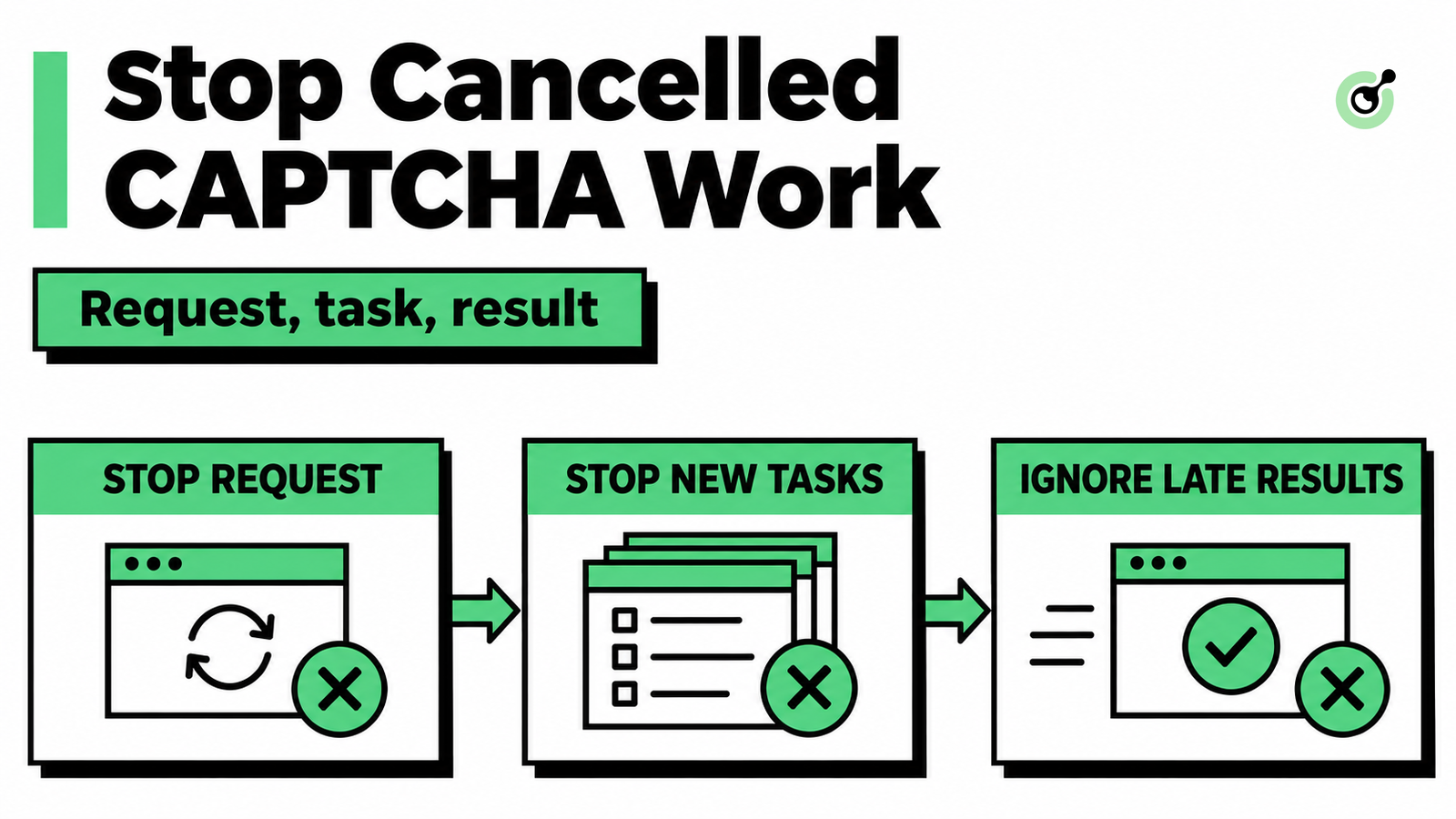
MCP CAPTCHA Cancellation: How to Stop Agent Tool Calls
Handle MCP CAPTCHA cancellation in AI agents. Stop new calls, distinguish remote tasks from local waits, and prevent late results from restarting work.
Khadija Santos
03-Nov-2026
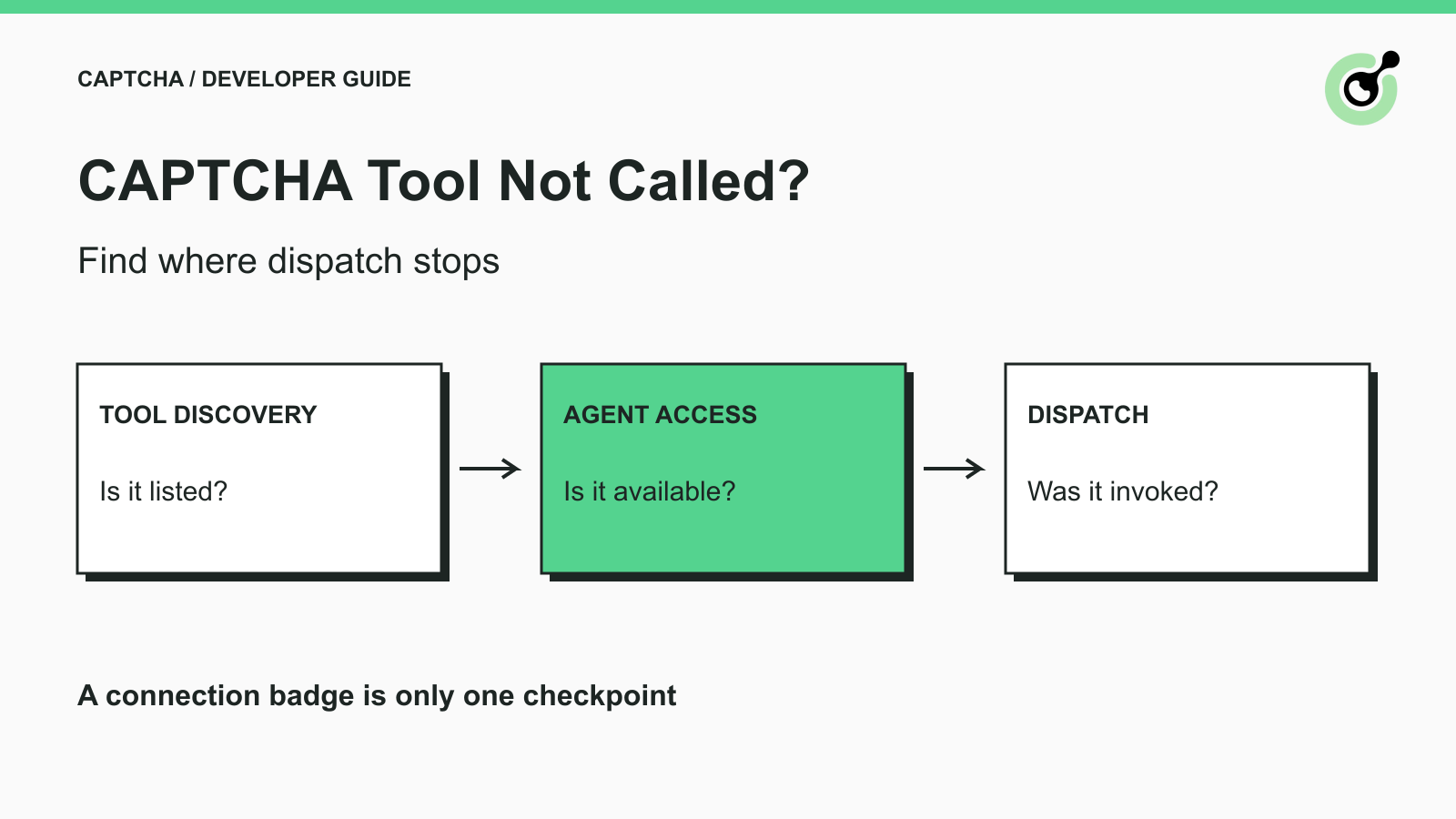
CAPTCHA Tool Connected but Your AI Agent Never Calls It?
Fix CAPTCHA tools that connect but never run. Check discovery, agent visibility, required inputs, approvals, and executor dispatch before changing solver settings.

Ethan Collins
02-Nov-2026
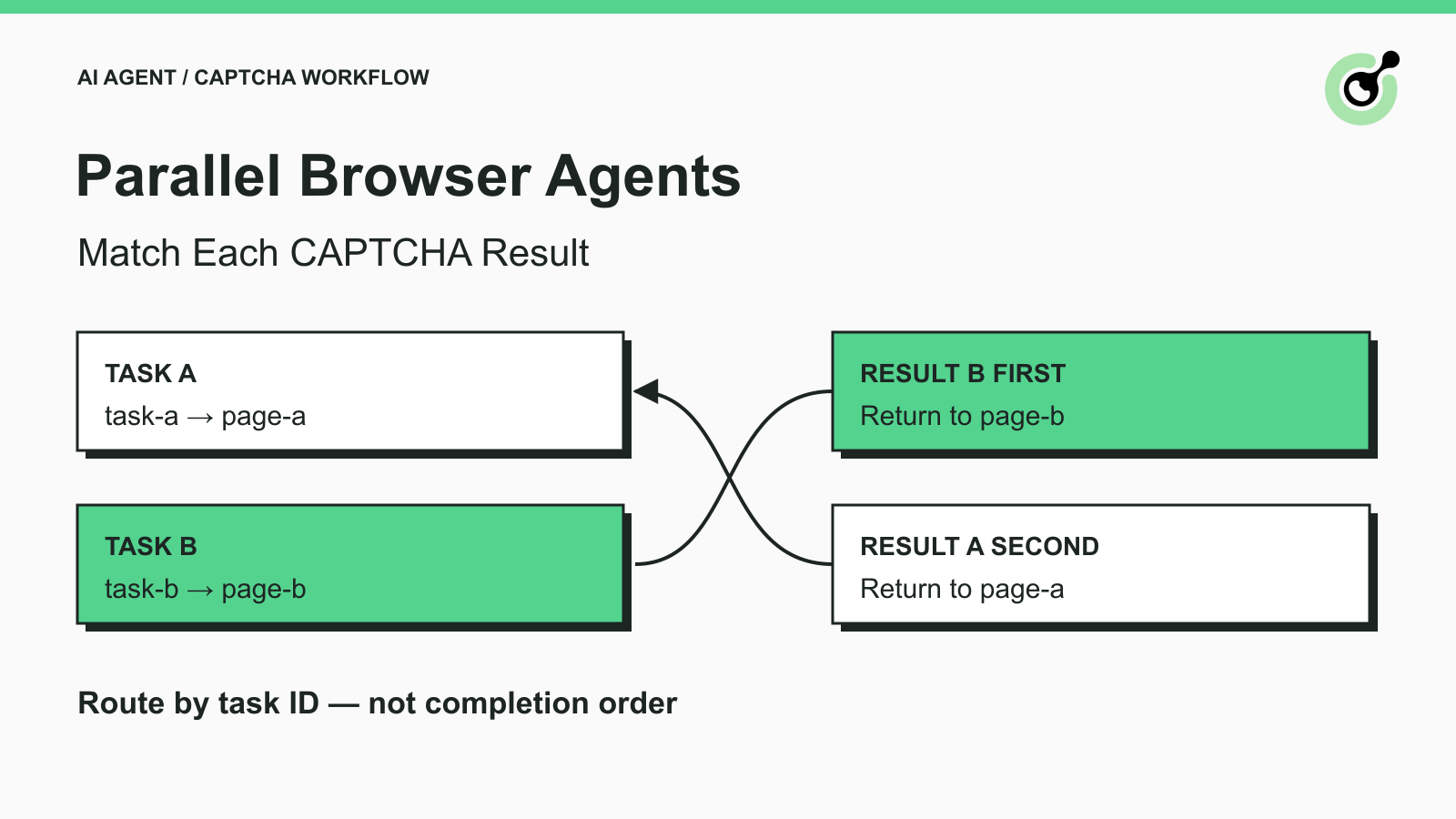
How to Match CAPTCHA Results to Parallel Browser Agent Tasks
Keep parallel browser agents from mixing CAPTCHA results. Map task IDs to page owners, reject stale responses, and test routing before applying a solution.
Khadija Santos
29-Oct-2026
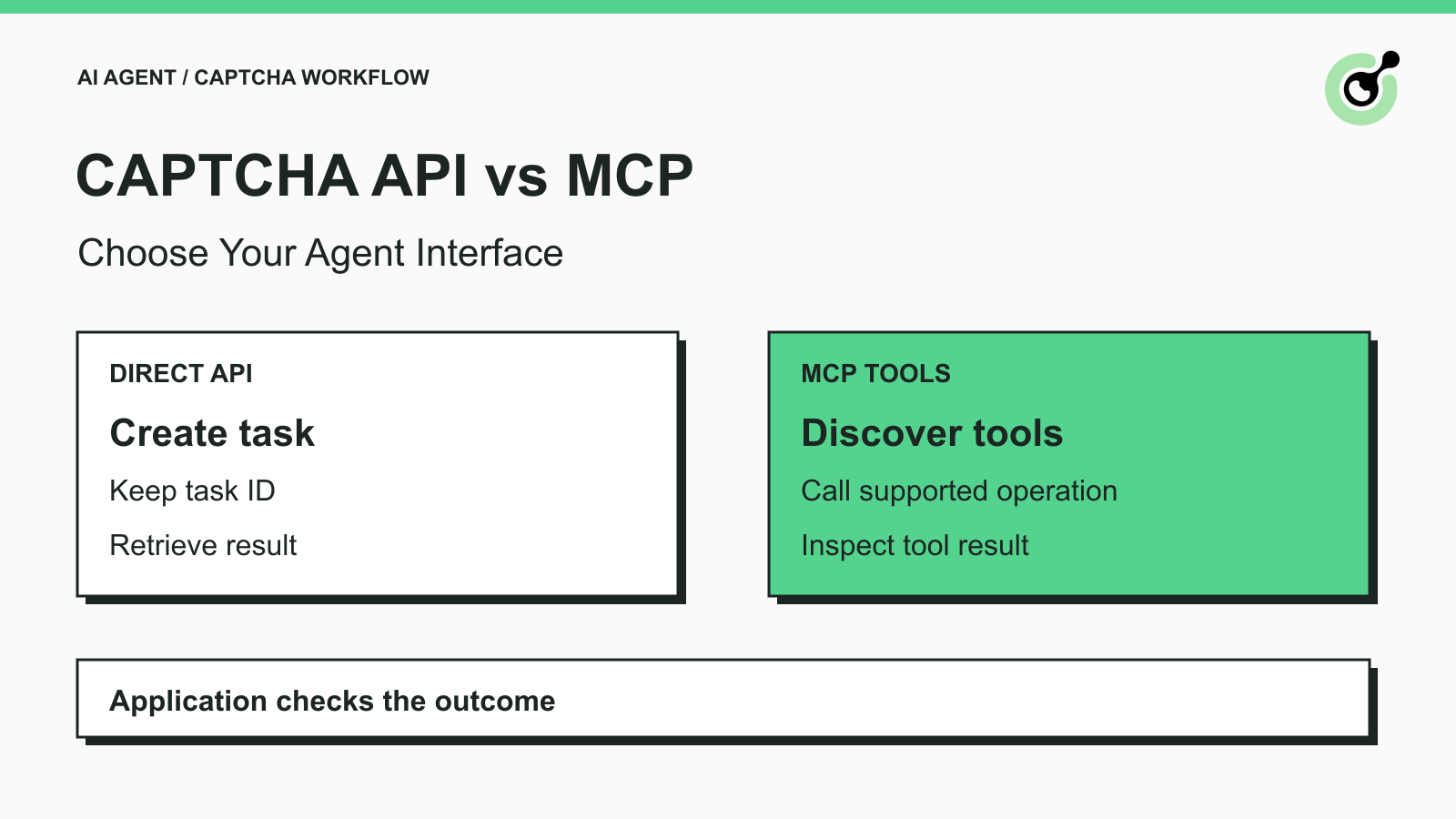
How to Choose Between a CAPTCHA API and MCP for AI Agents
Choose a CAPTCHA API or MCP for your AI agent by comparing task control, tool discovery, result handling, and browser responsibilities before you integrate.
Khadija Santos
29-Oct-2026
How to Fix CAPTCHA MCP Calls Using the Wrong Browser Session
Diagnose CAPTCHA MCP calls that open a different browser session. Inspect tool inputs, keep the original page, and verify the task before continuing.
Khadija Santos
28-Oct-2026
How to Return CAPTCHA Tool Results an AI Agent Can Use
Read CAPTCHA tool results correctly: distinguish transport errors, pending tasks, solver output, and browser success before letting an AI agent continue.
Khadija Santos
28-Oct-2026