











AI Agent CAPTCHA Timeout Error: Diagnosis and Recovery

Ethan Collins
How to use CapSolver
14-Aug-2026
TL;DR
- An ai agent captcha timeout error needs separate budgets for page readiness, tool transport, CAPTCHA work, and application confirmation.
- Late results must be discarded when the page URL, browser context, challenge, or authorized action has changed.
- One bounded retry may be reasonable for a transient transport failure, but repeated checkpoints should open a review path.
- The final pass condition is the original application state, never the absence of a thrown exception.
Introduction
An ai agent captcha timeout error is usually a coordination failure, not one generic slow request. The browser may still be loading, the tool call may be waiting, the CAPTCHA task may be running, or the protected application may reject a late result. CapSolver supplies documented agent and browser operations, but your orchestrator must assign separate deadlines and cancel stale work. This guide maps the timeout layers, adds a deterministic recovery state machine, and explains which evidence distinguishes delay from failure. The workflow supports only reCAPTCHA v2, reCAPTCHA v3 including Enterprise, and Cloudflare Turnstile in official agent paths. Keep every run lawful, reasonable, responsible, user-authorized, and limited to systems and data you may access.
Use Only the Documented AI Integration Surface
The implementation boundary for ai agent captcha timeout error is defined by CapSolver for AI Agents, Core SDK, Agent Tools, MCP Service. The overview explains the recovery-layer architecture; the Core SDK names the browser operations; Agent Tools names the function-tool adapter; and MCP Service names the discoverable service tools. Use capsolver-core, capsolver-agent, or capsolver-mcp according to the control plane you actually operate. Do not create substitute package names, tool names, parameters, or output fields. Official agent-layer content is limited here to reCAPTCHA v2, reCAPTCHA v3 including Enterprise, and Cloudflare Turnstile.
The input is an approved page, a solver created through the official Core SDK, and a local checkpoint policy. The output is a state record that the orchestrator must verify against the application. The autonomous stop conditions are a changed host, an exhausted attempt, a 90-second deadline, any result error, or an unfilled result.
python
import asyncio
from dataclasses import dataclass
from urllib.parse import urlparse

@dataclass
class Checkpoint:
    host: str
    action: str
    attempt: int = 0

async def run_bounded_recovery(page, solver, checkpoint):
    if urlparse(page.url).hostname != checkpoint.host:
        return {"state": "REVIEW", "reason": "host changed"}
    if checkpoint.attempt >= 1:
        return {"state": "REVIEW", "reason": "attempt budget exhausted"}

    try:
        async with asyncio.timeout(90):
            results = await solver.solve_on_page(page)
    except TimeoutError:
        return {"state": "TIMEOUT", "reason": "solver deadline exceeded"}

    if any(result.error or not result.filled for result in results):
        return {"state": "REVIEW", "reason": "incomplete recovery"}
    return {"state": "VERIFY_APPLICATION", "action": checkpoint.action}
Map the Four Timeout Clocks
ai agent captcha timeout error needs a clear deadline hierarchy for this stage. The record should cover page readiness, agent transport, solver operation, and application confirmation. These fields belong to one observation or checkpoint so later systems can explain exactly what changed. The practical rule is to measure each clock separately; the conservative boundary is to avoid one global timeout that hides the failing layer. A pipeline that omits this boundary may produce a technically successful request with an unusable or misleading business result.
Evidence packet: page readiness
Start with page readiness, then connect it to agent transport, solver operation, and application confirmation. Store values in typed fields rather than a free-form message. Include capture time, correlation ID, and the policy decision that permitted the operation. If a field is unavailable, preserve an explicit unknown state. Do not replace missing evidence with a default that looks like a real observation.
The surrounding workflow should compare the current packet with the immediately preceding valid packet. A difference in agent transport may be expected, while a difference in solver operation can invalidate the entire job. The decision engine should therefore emit ACCEPT, RETRY_ONCE, REVIEW, or STOP with a reason. Operational telemetry can follow W3C Trace Context while keeping credentials, cookies, raw solution values, and unnecessary page content out of logs.
Failure boundary: avoid one global timeout that hides the failing layer
The stop rule is operational, not decorative. When the workflow must avoid one global timeout that hides the failing layer, it should cancel pending child work, preserve a redacted evidence summary, and release its queue lock. The next run begins from a fresh authorized state rather than inheriting stale browser or task context. This behavior makes ai agent captcha timeout error auditable under load and prevents a small ambiguity from becoming repeated traffic.
The agent task checkpoint failures provides adjacent context for this decision. Use that material to understand the failure family, then keep this article's narrower contract: measure each clock separately. The output of the stage is a machine-readable state plus enough evidence for an operator to reproduce the decision. The output is not permission to expand scope, ignore a rate signal, or access data outside the approved purpose.
Name the Terminal States
ai agent captcha timeout error needs a clear state machine for this stage. The record should cover WAITING_PAGE, CALLING_TOOL, SOLVING, VERIFYING, COMPLETE, TIMEOUT, and REVIEW. These fields belong to one observation or checkpoint so later systems can explain exactly what changed. The practical rule is to allow only explicit transitions; the conservative boundary is to reject transitions from stale browser states. A pipeline that omits this boundary may produce a technically successful request with an unusable or misleading business result.
Normalization rule: WAITING_PAGE
Start with WAITING_PAGE, then connect it to CALLING_TOOL, SOLVING, VERIFYING. Store values in typed fields rather than a free-form message. Include capture time, correlation ID, and the policy decision that permitted the operation. If a field is unavailable, preserve an explicit unknown state. Do not replace missing evidence with a default that looks like a real observation.
The surrounding workflow should compare the current packet with the immediately preceding valid packet. A difference in CALLING_TOOL may be expected, while a difference in SOLVING can invalidate the entire job. The decision engine should therefore emit ACCEPT, RETRY_ONCE, REVIEW, or STOP with a reason. Evidence retention should reflect OWASP Logging Guidance while keeping credentials, cookies, raw solution values, and unnecessary page content out of logs.
Operator decision: reject transitions from stale browser states
The stop rule is operational, not decorative. When the workflow must reject transitions from stale browser states, it should cancel pending child work, preserve a redacted evidence summary, and release its queue lock. The next run begins from a fresh authorized state rather than inheriting stale browser or task context. This behavior makes ai agent captcha timeout error auditable under load and prevents a small ambiguity from becoming repeated traffic.
The rate-limit recovery for agents provides adjacent context for this decision. Use that material to understand the failure family, then keep this article's narrower contract: allow only explicit transitions. The output of the stage is a machine-readable state plus enough evidence for an operator to reproduce the decision. The output is not permission to expand scope, ignore a rate signal, or access data outside the approved purpose.
Preserve the Checkpoint Identity
ai agent captcha timeout error needs a clear context fingerprint for this stage. The record should cover hostname, route, action, frame identity, challenge type, and attempt number. These fields belong to one observation or checkpoint so later systems can explain exactly what changed. The practical rule is to compare before using a result; the conservative boundary is to discard late output after navigation. A pipeline that omits this boundary may produce a technically successful request with an unusable or misleading business result.
Control decision: hostname
Start with hostname, then connect it to route, action, frame identity. Store values in typed fields rather than a free-form message. Include capture time, correlation ID, and the policy decision that permitted the operation. If a field is unavailable, preserve an explicit unknown state. Do not replace missing evidence with a default that looks like a real observation.
The surrounding workflow should compare the current packet with the immediately preceding valid packet. A difference in route may be expected, while a difference in action can invalidate the entire job. The decision engine should therefore emit ACCEPT, RETRY_ONCE, REVIEW, or STOP with a reason. Timeout and trace design can use Python asyncio Timeouts while keeping credentials, cookies, raw solution values, and unnecessary page content out of logs.
Stop condition: discard late output after navigation
The stop rule is operational, not decorative. When the workflow must discard late output after navigation, it should cancel pending child work, preserve a redacted evidence summary, and release its queue lock. The next run begins from a fresh authorized state rather than inheriting stale browser or task context. This behavior makes ai agent captcha timeout error auditable under load and prevents a small ambiguity from becoming repeated traffic.
The agent CAPTCHA middleware provides adjacent context for this decision. Use that material to understand the failure family, then keep this article's narrower contract: compare before using a result. The output of the stage is a machine-readable state plus enough evidence for an operator to reproduce the decision. The output is not permission to expand scope, ignore a rate signal, or access data outside the approved purpose.
Cancel Work Without Losing Evidence
ai agent captcha timeout error needs a clear cancellation path for this stage. The record should cover trace ID, start time, deadline, cancellation reason, task identifier, and page snapshot hash. These fields belong to one observation or checkpoint so later systems can explain exactly what changed. The practical rule is to record metadata before cancellation; the conservative boundary is to never store raw tokens or cookies. A pipeline that omits this boundary may produce a technically successful request with an unusable or misleading business result.
State evidence: trace ID
Start with trace ID, then connect it to start time, deadline, cancellation reason. Store values in typed fields rather than a free-form message. Include capture time, correlation ID, and the policy decision that permitted the operation. If a field is unavailable, preserve an explicit unknown state. Do not replace missing evidence with a default that looks like a real observation.
The surrounding workflow should compare the current packet with the immediately preceding valid packet. A difference in start time may be expected, while a difference in deadline can invalidate the entire job. The decision engine should therefore emit ACCEPT, RETRY_ONCE, REVIEW, or STOP with a reason. Implementation boundaries are consistent with W3C Trace Context while keeping credentials, cookies, raw solution values, and unnecessary page content out of logs.
Production guardrail: never store raw tokens or cookies
The stop rule is operational, not decorative. When the workflow must never store raw tokens or cookies, it should cancel pending child work, preserve a redacted evidence summary, and release its queue lock. The next run begins from a fresh authorized state rather than inheriting stale browser or task context. This behavior makes ai agent captcha timeout error auditable under load and prevents a small ambiguity from becoming repeated traffic.
The MCP CAPTCHA error diagnosis provides adjacent context for this decision. Use that material to understand the failure family, then keep this article's narrower contract: record metadata before cancellation. The output of the stage is a machine-readable state plus enough evidence for an operator to reproduce the decision. The output is not permission to expand scope, ignore a rate signal, or access data outside the approved purpose.
Choose a Retry Policy by Failure Class
ai agent captcha timeout error needs a clear retry decision for this stage. The record should cover connect timeout, read timeout, solver deadline, repeated challenge, application rejection, and policy change. These fields belong to one observation or checkpoint so later systems can explain exactly what changed. The practical rule is to retry only transient failures once; the conservative boundary is to make semantic failures terminal. A pipeline that omits this boundary may produce a technically successful request with an unusable or misleading business result.
Validation boundary: connect timeout
Start with connect timeout, then connect it to read timeout, solver deadline, repeated challenge. Store values in typed fields rather than a free-form message. Include capture time, correlation ID, and the policy decision that permitted the operation. If a field is unavailable, preserve an explicit unknown state. Do not replace missing evidence with a default that looks like a real observation.
The surrounding workflow should compare the current packet with the immediately preceding valid packet. A difference in read timeout may be expected, while a difference in solver deadline can invalidate the entire job. The decision engine should therefore emit ACCEPT, RETRY_ONCE, REVIEW, or STOP with a reason. Operational telemetry can follow OWASP Logging Guidance while keeping credentials, cookies, raw solution values, and unnecessary page content out of logs.
Review branch: make semantic failures terminal
The stop rule is operational, not decorative. When the workflow must make semantic failures terminal, it should cancel pending child work, preserve a redacted evidence summary, and release its queue lock. The next run begins from a fresh authorized state rather than inheriting stale browser or task context. This behavior makes ai agent captcha timeout error auditable under load and prevents a small ambiguity from becoming repeated traffic.
The wrong-solution agent diagnosis provides adjacent context for this decision. Use that material to understand the failure family, then keep this article's narrower contract: retry only transient failures once. The output of the stage is a machine-readable state plus enough evidence for an operator to reproduce the decision. The output is not permission to expand scope, ignore a rate signal, or access data outside the approved purpose.
Redeem Your CapSolver Bonus Code
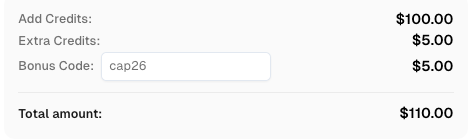
Boost your automation budget instantly!
Use bonus code CAP26 when topping up your CapSolver account to get an extra 5% bonus on every recharge — with no limits.
Redeem it now in your CapSolver Dashboard
Coordinate Agent and MCP Time Budgets
ai agent captcha timeout error needs a clear transport boundary for this stage. The record should cover client deadline, server deadline, subprocess lifecycle, MCP response, and orchestrator cancellation. These fields belong to one observation or checkpoint so later systems can explain exactly what changed. The practical rule is to keep the shortest deadline explicit; the conservative boundary is to stop orphaned tool work. A pipeline that omits this boundary may produce a technically successful request with an unusable or misleading business result.
Evidence packet: client deadline
Start with client deadline, then connect it to server deadline, subprocess lifecycle, MCP response. Store values in typed fields rather than a free-form message. Include capture time, correlation ID, and the policy decision that permitted the operation. If a field is unavailable, preserve an explicit unknown state. Do not replace missing evidence with a default that looks like a real observation.
The surrounding workflow should compare the current packet with the immediately preceding valid packet. A difference in server deadline may be expected, while a difference in subprocess lifecycle can invalidate the entire job. The decision engine should therefore emit ACCEPT, RETRY_ONCE, REVIEW, or STOP with a reason. Evidence retention should reflect Python asyncio Timeouts while keeping credentials, cookies, raw solution values, and unnecessary page content out of logs.
Failure boundary: stop orphaned tool work
The stop rule is operational, not decorative. When the workflow must stop orphaned tool work, it should cancel pending child work, preserve a redacted evidence summary, and release its queue lock. The next run begins from a fresh authorized state rather than inheriting stale browser or task context. This behavior makes ai agent captcha timeout error auditable under load and prevents a small ambiguity from becoming repeated traffic.
The timeout definition provides adjacent context for this decision. Use that material to understand the failure family, then keep this article's narrower contract: keep the shortest deadline explicit. The output of the stage is a machine-readable state plus enough evidence for an operator to reproduce the decision. The output is not permission to expand scope, ignore a rate signal, or access data outside the approved purpose.
Verify the Application After Recovery
ai agent captcha timeout error needs a clear business assertion for this stage. The record should cover expected route, response code, confirmation text, record count, and action correlation. These fields belong to one observation or checkpoint so later systems can explain exactly what changed. The practical rule is to treat verification as a separate stage; the conservative boundary is to do not call a ready tool result complete. A pipeline that omits this boundary may produce a technically successful request with an unusable or misleading business result.
Normalization rule: expected route
Start with expected route, then connect it to response code, confirmation text, record count. Store values in typed fields rather than a free-form message. Include capture time, correlation ID, and the policy decision that permitted the operation. If a field is unavailable, preserve an explicit unknown state. Do not replace missing evidence with a default that looks like a real observation.
The surrounding workflow should compare the current packet with the immediately preceding valid packet. A difference in response code may be expected, while a difference in confirmation text can invalidate the entire job. The decision engine should therefore emit ACCEPT, RETRY_ONCE, REVIEW, or STOP with a reason. Timeout and trace design can use W3C Trace Context while keeping credentials, cookies, raw solution values, and unnecessary page content out of logs.
Operator decision: do not call a ready tool result complete
The stop rule is operational, not decorative. When the workflow must do not call a ready tool result complete, it should cancel pending child work, preserve a redacted evidence summary, and release its queue lock. The next run begins from a fresh authorized state rather than inheriting stale browser or task context. This behavior makes ai agent captcha timeout error auditable under load and prevents a small ambiguity from becoming repeated traffic.
The agent task checkpoint failures provides adjacent context for this decision. Use that material to understand the failure family, then keep this article's narrower contract: treat verification as a separate stage. The output of the stage is a machine-readable state plus enough evidence for an operator to reproduce the decision. The output is not permission to expand scope, ignore a rate signal, or access data outside the approved purpose.
Add a Circuit Breaker for Shared Failures
ai agent captcha timeout error needs a clear fleet protection for this stage. The record should cover rolling timeout rate, host group, challenge type, tool version, and cooldown interval. These fields belong to one observation or checkpoint so later systems can explain exactly what changed. The practical rule is to open the circuit on correlated failures; the conservative boundary is to protect sites and queues from retry storms. A pipeline that omits this boundary may produce a technically successful request with an unusable or misleading business result.
Control decision: rolling timeout rate
Start with rolling timeout rate, then connect it to host group, challenge type, tool version. Store values in typed fields rather than a free-form message. Include capture time, correlation ID, and the policy decision that permitted the operation. If a field is unavailable, preserve an explicit unknown state. Do not replace missing evidence with a default that looks like a real observation.
The surrounding workflow should compare the current packet with the immediately preceding valid packet. A difference in host group may be expected, while a difference in challenge type can invalidate the entire job. The decision engine should therefore emit ACCEPT, RETRY_ONCE, REVIEW, or STOP with a reason. Implementation boundaries are consistent with OWASP Logging Guidance while keeping credentials, cookies, raw solution values, and unnecessary page content out of logs.
Stop condition: protect sites and queues from retry storms
The stop rule is operational, not decorative. When the workflow must protect sites and queues from retry storms, it should cancel pending child work, preserve a redacted evidence summary, and release its queue lock. The next run begins from a fresh authorized state rather than inheriting stale browser or task context. This behavior makes ai agent captcha timeout error auditable under load and prevents a small ambiguity from becoming repeated traffic.
The rate-limit recovery for agents provides adjacent context for this decision. Use that material to understand the failure family, then keep this article's narrower contract: open the circuit on correlated failures. The output of the stage is a machine-readable state plus enough evidence for an operator to reproduce the decision. The output is not permission to expand scope, ignore a rate signal, or access data outside the approved purpose.
Test with Injected Delay and Navigation
ai agent captcha timeout error needs a clear fault injection for this stage. The record should cover slow page, delayed frame, transport interruption, deadline expiry, route change, and duplicate checkpoint. These fields belong to one observation or checkpoint so later systems can explain exactly what changed. The practical rule is to assert cancellation and cleanup; the conservative boundary is to prove no retry continues after review. A pipeline that omits this boundary may produce a technically successful request with an unusable or misleading business result.
State evidence: slow page
Start with slow page, then connect it to delayed frame, transport interruption, deadline expiry. Store values in typed fields rather than a free-form message. Include capture time, correlation ID, and the policy decision that permitted the operation. If a field is unavailable, preserve an explicit unknown state. Do not replace missing evidence with a default that looks like a real observation.
The surrounding workflow should compare the current packet with the immediately preceding valid packet. A difference in delayed frame may be expected, while a difference in transport interruption can invalidate the entire job. The decision engine should therefore emit ACCEPT, RETRY_ONCE, REVIEW, or STOP with a reason. Operational telemetry can follow Python asyncio Timeouts while keeping credentials, cookies, raw solution values, and unnecessary page content out of logs.
Production guardrail: prove no retry continues after review
The stop rule is operational, not decorative. When the workflow must prove no retry continues after review, it should cancel pending child work, preserve a redacted evidence summary, and release its queue lock. The next run begins from a fresh authorized state rather than inheriting stale browser or task context. This behavior makes ai agent captcha timeout error auditable under load and prevents a small ambiguity from becoming repeated traffic.
The agent CAPTCHA middleware provides adjacent context for this decision. Use that material to understand the failure family, then keep this article's narrower contract: assert cancellation and cleanup. The output of the stage is a machine-readable state plus enough evidence for an operator to reproduce the decision. The output is not permission to expand scope, ignore a rate signal, or access data outside the approved purpose.
Write an Operator Runbook
ai agent captcha timeout error needs a clear incident response for this stage. The record should cover symptom, failing clock, evidence location, safe retry rule, escalation owner, and recovery criterion. These fields belong to one observation or checkpoint so later systems can explain exactly what changed. The practical rule is to make actions reproducible; the conservative boundary is to resume only after the root condition is understood. A pipeline that omits this boundary may produce a technically successful request with an unusable or misleading business result.
Validation boundary: symptom
Start with symptom, then connect it to failing clock, evidence location, safe retry rule. Store values in typed fields rather than a free-form message. Include capture time, correlation ID, and the policy decision that permitted the operation. If a field is unavailable, preserve an explicit unknown state. Do not replace missing evidence with a default that looks like a real observation.
The surrounding workflow should compare the current packet with the immediately preceding valid packet. A difference in failing clock may be expected, while a difference in evidence location can invalidate the entire job. The decision engine should therefore emit ACCEPT, RETRY_ONCE, REVIEW, or STOP with a reason. Evidence retention should reflect W3C Trace Context while keeping credentials, cookies, raw solution values, and unnecessary page content out of logs.
Review branch: resume only after the root condition is understood
The stop rule is operational, not decorative. When the workflow must resume only after the root condition is understood, it should cancel pending child work, preserve a redacted evidence summary, and release its queue lock. The next run begins from a fresh authorized state rather than inheriting stale browser or task context. This behavior makes ai agent captcha timeout error auditable under load and prevents a small ambiguity from becoming repeated traffic.
The MCP CAPTCHA error diagnosis provides adjacent context for this decision. Use that material to understand the failure family, then keep this article's narrower contract: make actions reproducible. The output of the stage is a machine-readable state plus enough evidence for an operator to reproduce the decision. The output is not permission to expand scope, ignore a rate signal, or access data outside the approved purpose.
Conclusion
ai agent captcha timeout error is reliable only when each stage has a defined input, typed output, evidence record, and terminal stop condition. The workflow should preserve authorization and context, use official CapSolver surfaces, keep retries bounded, and validate the original application or business state after every recovery. Teams operating lawful and permitted automation can evaluate CapSolver for the documented CAPTCHA layer while retaining deterministic policy and review controls in their own application.
FAQ
Q: What causes an ai agent captcha timeout error?
An ai agent captcha timeout error occurs when one deadline expires before browser detection, tool transport, CAPTCHA work, or application confirmation finishes.
Q: How long should an agent wait?
Use a measured per-stage budget from your authorized test environment and keep an absolute upper deadline; the example uses 90 seconds only as an application policy.
Q: Can the agent reuse a late result?
No. Discard a late result when the host, route, frame, challenge, browser context, or authorized action has changed.
Q: Should every timeout be retried?
No. Retry only a clearly transient failure once; repeated challenges, policy changes, and application rejection require review.
Q: Which CAPTCHA types belong in the official agent path?
Limit the agent workflow to the currently documented reCAPTCHA v2, reCAPTCHA v3 including Enterprise, and Cloudflare Turnstile support.
Compliance Disclaimer: The information provided on this blog is for informational purposes only. CapSolver is committed to compliance with all applicable laws and regulations. The use of the CapSolver network for illegal, fraudulent, or abusive activities is strictly prohibited and will be investigated. Our captcha-solving solutions enhance user experience while ensuring 100% compliance in helping solve captcha difficulties during public data crawling. We encourage responsible use of our services. For more information, please visit our Terms of Service and Privacy Policy.
More
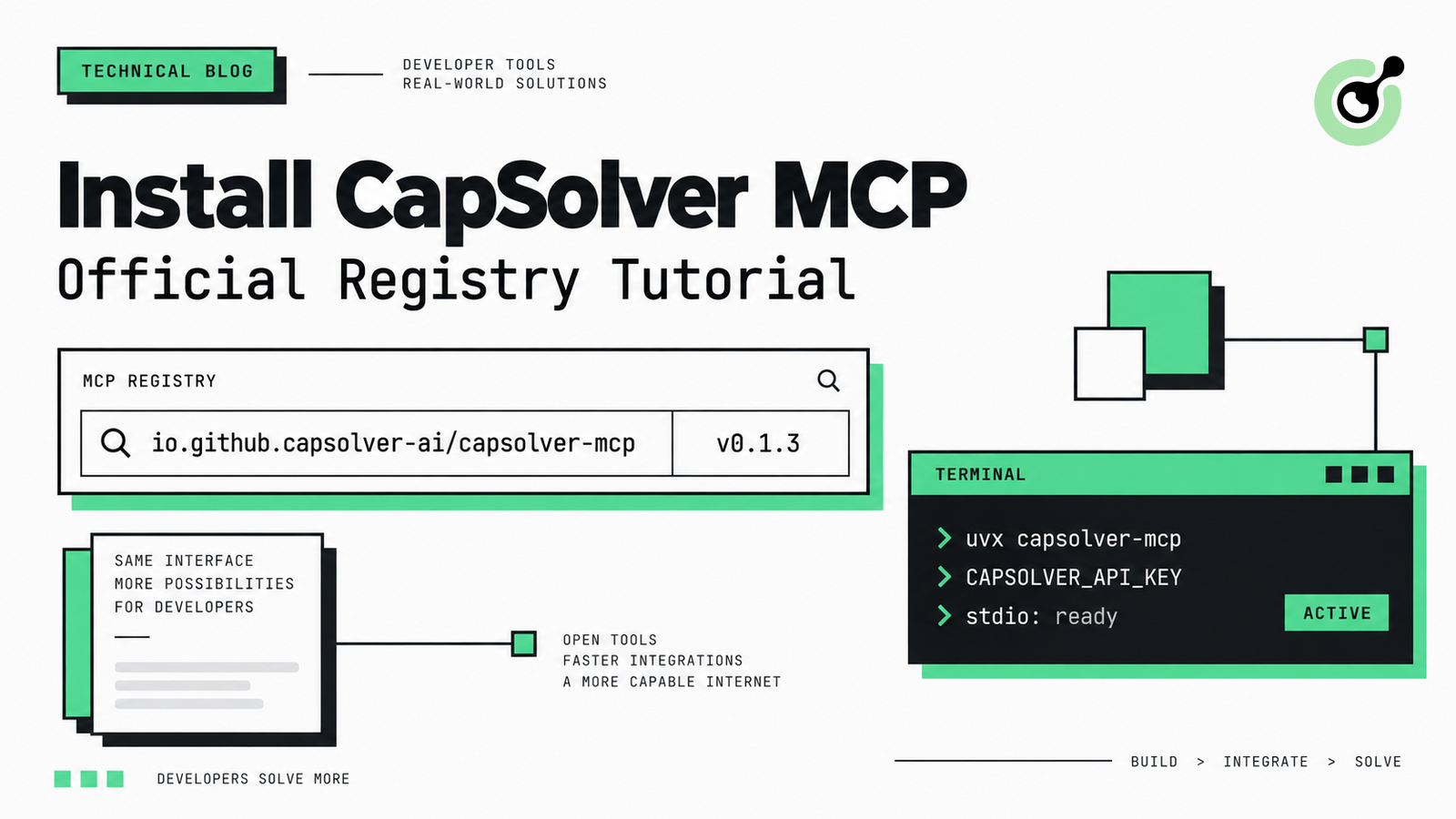
How to Install CapSolver MCP from the Official MCP Registry
Find CapSolver MCP in the Official MCP Registry, install version 0.1.3 with uvx or pip, configure a local client, and verify the stdio tools.

Khadija Santos
18-Sep-2026
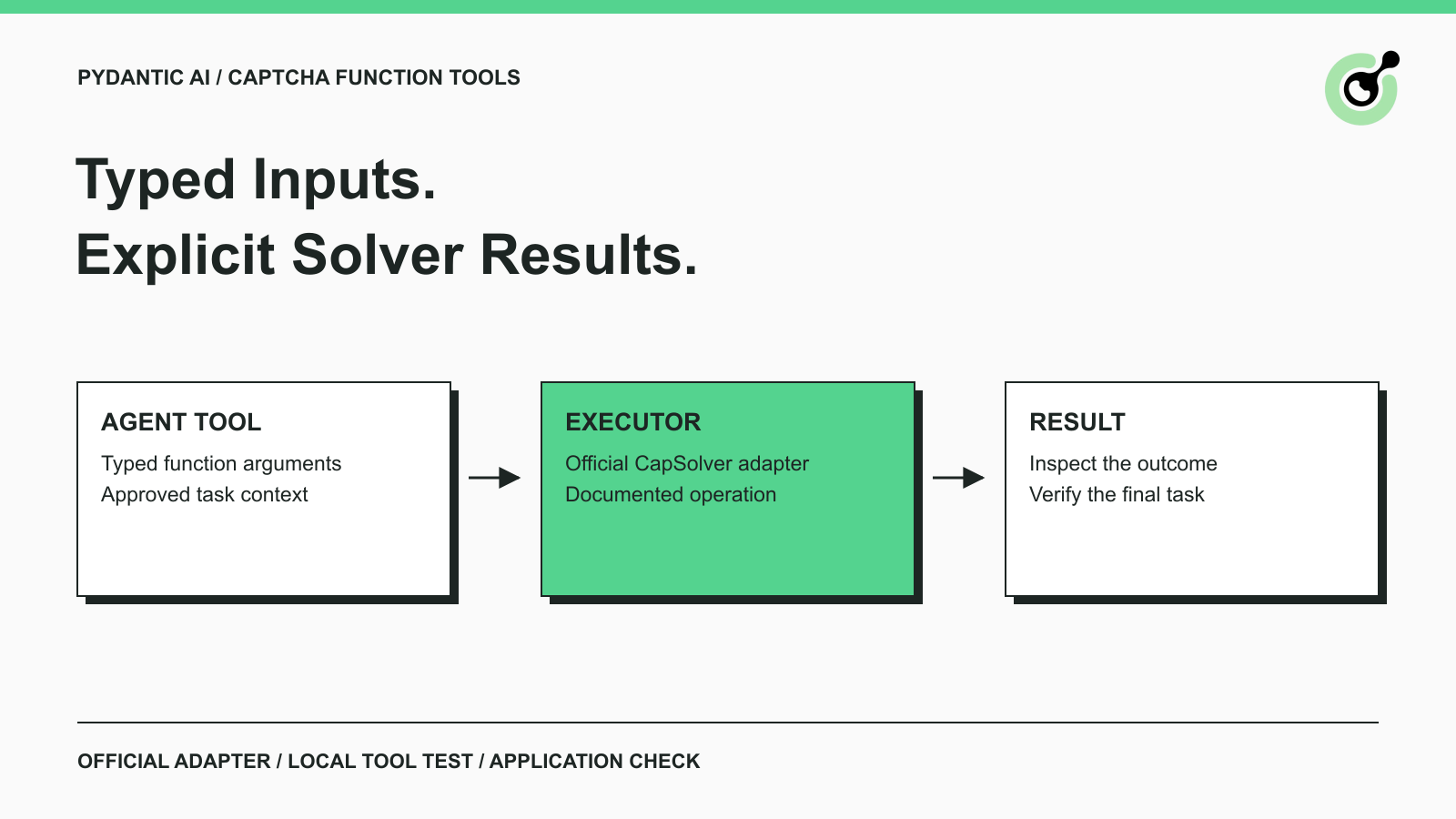
Pydantic AI CAPTCHA Tools: Typed Inputs and Solver Results
Add CAPTCHA tools to Pydantic AI using the official CapSolver adapter, test tool execution locally, and handle typed inputs and structured solver results.
Khadija Santos
18-Sep-2026
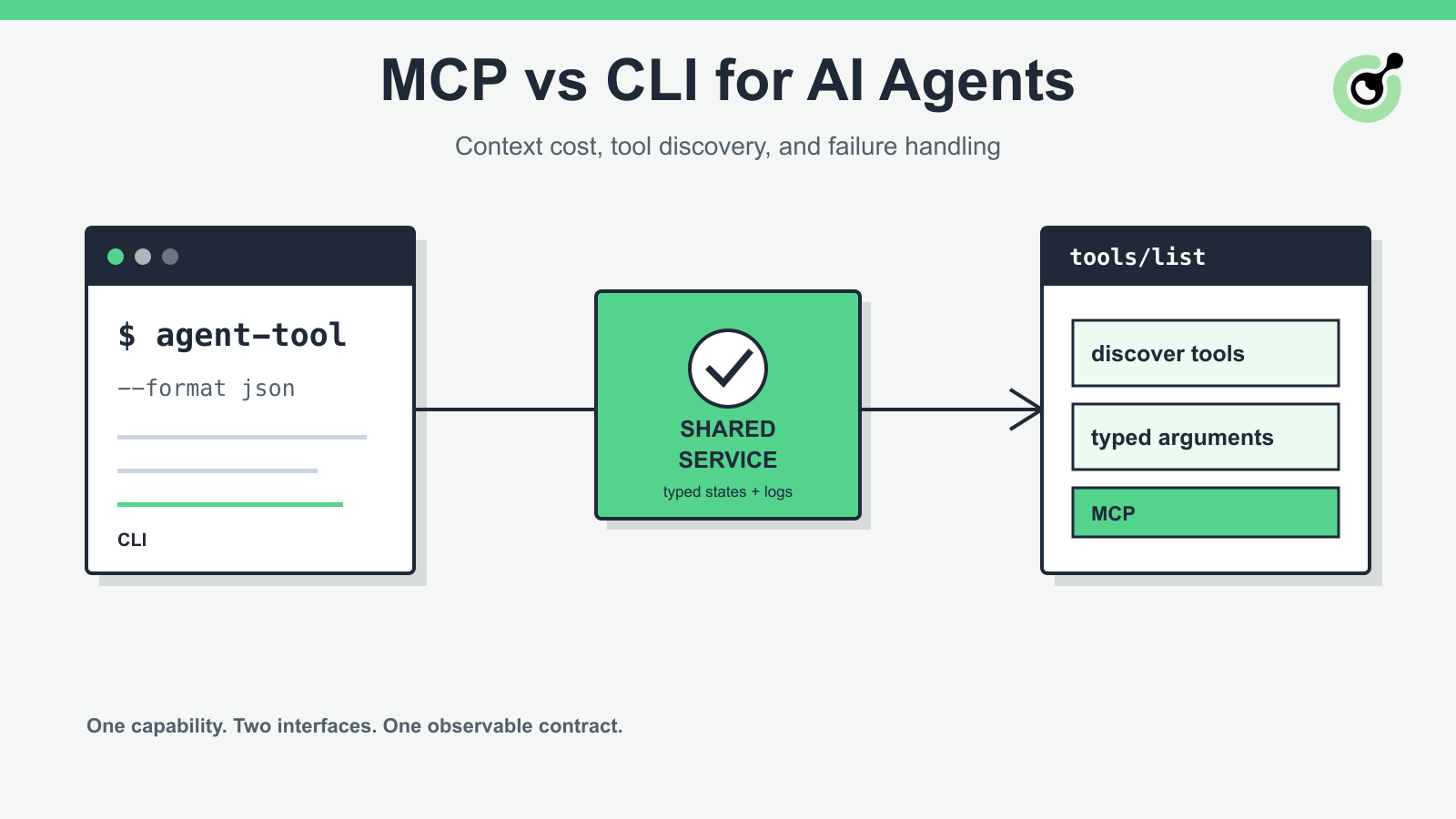
MCP vs CLI for AI Agents: Context Cost and Failure Handling
Compare MCP and CLI interfaces for AI agents across tool discovery, context cost, security, debugging, failure handling, and hybrid architecture.

Nikolai Smirnov
18-Sep-2026
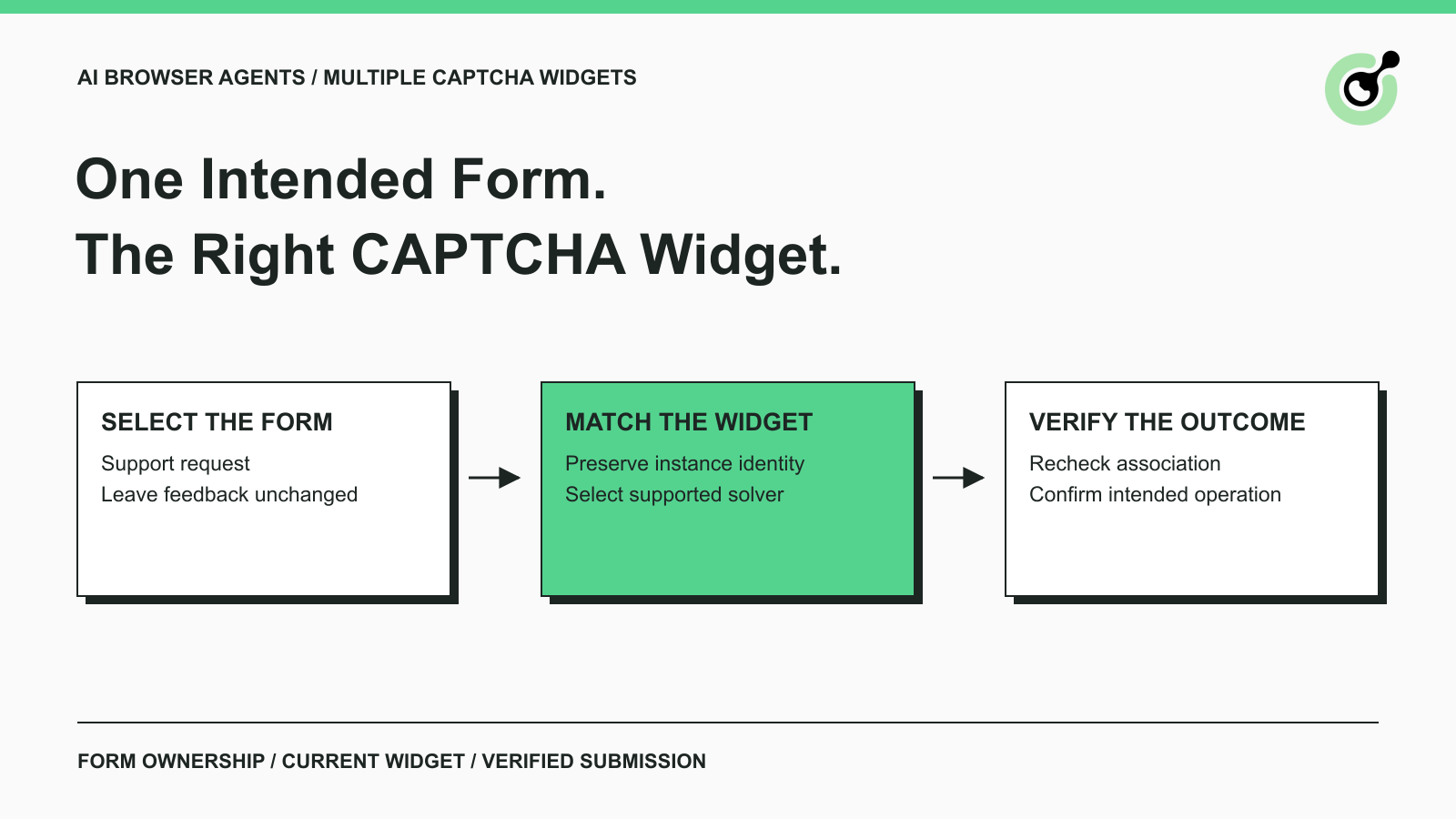
How to Handle Multiple CAPTCHA Widgets in AI Browser Agents
Handle multiple CAPTCHA widgets on one page with explicit form ownership, solver parameters, result routing, and checks for the intended AI agent action.

Lucas Mitchell
15-Sep-2026

CapSolver MCP Server Is Now Available for AI Agents
Install CapSolver MCP Server from PyPI and give compatible AI agents five tools for authorized CAPTCHA handling through the Model Context Protocol.

Sora Fujimoto
11-Sep-2026

AI Agents vs Scripts: How to Choose for Web Automation
Choose between AI agents, scripts, and hybrid web automation by task uncertainty, testability, cost, and the controls needed for reliable execution.
Lucas Mitchell
11-Sep-2026