











How to Design Web Scraping Access and Extraction Layers for AI Agents

Lucas Mitchell
How to use CapSolver
10-Sep-2026
TL;DR
- A web access layer obtains an eligible, usable page snapshot; a data extraction layer turns that snapshot into candidate records.
- Keep rendering, session state, network failures, and supported CAPTCHA handling on the access side of the boundary.
- Validate extracted JSON for required fields, source support, completeness, and freshness before an AI agent uses it.
- Retry a transient read within a small budget; defer rate limits and stop for authorization or challenge review.
- Replay extraction against a retained snapshot when parsing fails instead of automatically requesting the page again.
- The Python example runs locally with synthetic HTML and exercises both layers without contacting a website or calling a model.
An AI agent can receive a valid-looking record from the wrong page. A login screen may contain a heading, an incomplete document may parse successfully, and a model may return JSON even when the requested facts are missing. An AI agent web scraping architecture needs separate decisions for reaching the source and interpreting its contents.
This tutorial designs that boundary around an immutable snapshot and a versioned record contract. The workflow applies to authorized collection of public notices, documentation updates, and other permitted web information. CapSolver appears as a supported CAPTCHA-handling capability in the access layer. The runnable example then shows how to classify acquisition outcomes, extract a small record set, and preserve evidence when validation fails.
Define the Access and Extraction Layer Contracts
The access layer should return either a usable snapshot or an explicit failure; the extraction layer should return candidate records tied to that snapshot. Keep both contracts stable even when the browser runtime, parser, or model changes.
The pipeline is: approved collection request → access adapter → retained snapshot → extraction adapter → validation → accepted-record store → agent. In this design, extraction can run again from stored evidence without reopening a browser.
The web access layer owns page acquisition
Give the access adapter an approved source, a task identity, a time budget, and a permitted session context. Its job includes choosing the required representation, waiting for relevant content, preserving session ownership, and classifying failures. Network configuration and JavaScript rendering belong to your HTTP or browser infrastructure.
The output should record the requested and final source locations, observation time, representation type, content digest, and readiness evidence. Avoid a single success flag that conceals which page actually loaded. A final URL and an HTTP status help, but the expected document identity and required content regions also need checks.
The data extraction layer owns interpretation
Give the extractor a snapshot reference, schema version, and field definitions. It should not silently navigate, change credentials, or select another network route. Return missing or ambiguous fields explicitly instead of asking the access layer to keep trying until some value appears.
The AI web scraping glossary describes the broader use of AI in collecting and interpreting web information. The boundary here also supports deterministic extraction: stable attributes or documented structured data may be sufficient. Use a model when the interpretation requires it, while preserving the same downstream validation contract.
Capture the Right Evidence Before Extracting Fields
A usable snapshot must contain the evidence needed for the requested fields, in a representation the extractor understands. Select HTML, rendered DOM, or a screenshot according to that requirement.
HTML and rendered DOM
Raw HTML is appropriate when the response already contains the relevant content. If necessary fields appear only after client-side execution, a browser adapter should capture the rendered DOM after a task-specific readiness check. Define readiness as an observable condition, such as the expected record container and completion marker, rather than a universal fixed sleep.
Record which representation was captured. A parser tested on rendered markup should not receive an initial HTML shell without an explicit contract change. If a required region is absent, classify the snapshot as incomplete before attempting extraction.
Screenshots and visual interpretation
A screenshot provides pixels from a particular viewport at a particular time. For screenshot-based extraction, retain the image dimensions, capture context, and a region reference for each extracted field. If a value lies outside the captured view, return it as missing; a model's familiarity with similar layouts is not evidence for that value.
Do not convert a visual estimate into an exact number without recording the uncertainty. Where both DOM and visual evidence are available, use disagreements as review cases. The sample below implements only an HTML adapter; a vision adapter would need its own evidence checks and evaluation set.
Classify Failures Before Deciding to Retry
A retry decision should name the failing layer, the expected benefit of another attempt, and the remaining budget. Keep acquisition and interpretation retries separate so an extraction error cannot create uncontrolled traffic.
| Observation | Owning layer | Recommended action |
|---|---|---|
| Read timeout or a selected temporary service error | Access | Retry only a permitted read within its time and attempt budgets |
| HTTP 429 or a service-requested cooldown | Access | Defer to a shared scheduler and preserve the cooldown signal |
| HTTP 401/403 or unclear authorization | Access | Stop and review the permitted access path |
| Recognized CAPTCHA challenge | Access | Pause for eligibility and supported-task review |
| Empty response, wrong document, or missing required region | Access | Retain diagnostic evidence and investigate readiness |
| Missing field, invalid date, duplicate record, or schema mismatch | Extraction/validation | Quarantine the candidate and replay against the snapshot |
| Valid shape but unsupported meaning | Validation | Reject or request review; do not treat fluent text as evidence |
HTTP semantics matter when implementing the first row. RFC 9110's retry and idempotency rules distinguish operations that can safely be repeated from operations whose effects may be uncertain. Do not reuse a read-retry loop for form submissions or other state-changing actions.
The Retry-After header can express a delay or an HTTP date. Preserve the value for scheduling. A local worker should not replace a server-requested wait with a shorter backoff, and workers sharing the same permitted collection scope should share cooldown state.
Add CAPTCHA Handling Through a Narrow Access Adapter
CapSolver should handle only a documented CAPTCHA task after your workflow has established permission, task compatibility, and the required session context. A 403 response, an empty page, and a CAPTCHA widget are distinct observations; avoid mapping all of them to a solve request.
CapSolver's createTask contract requires the appropriate task object. For asynchronous work, getTaskResult returns task status and output. The access adapter remains responsible for applying the documented integration and checking the destination afterward.
A completed task is not a validated page snapshot. Recheck the document identity and readiness conditions before handing content to extraction. Set a separate challenge budget and stop when the challenge is unsupported, authorization is unclear, or the expected page remains unavailable. The AI agent browser infrastructure stack provides related guidance on runtime ownership and session evidence.
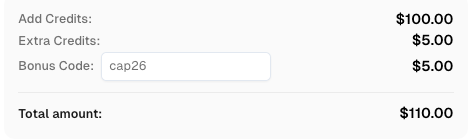
Redeem Your CapSolver Bonus Code
Boost your automation budget instantly!
Use bonus code CAP26 when topping up your CapSolver account to get an extra 5% bonus on every recharge — with no limits.
Redeem it now in your CapSolver Dashboard
Run a Python Workflow with Separate Failure Boundaries
The following Python workflow classifies synthetic access replies, retains accepted HTML, extracts bulletin fields, and returns structured JSON. Save it as pipeline_example.py and run it with Python 3.9 or later; it uses only the standard library.
The fetch function is an injected read-only adapter. Here it supplies in-memory fixtures, and the demonstration disables sleeping. No website, browser service, model, or CAPTCHA API is contacted. The challenge and ready fields represent observations supplied by an access adapter; the example does not implement a universal challenge detector.
The parser uses Python's HTMLParser callbacks for a deliberately small markup contract: each article contains one h2, a record ID, and a publication date. It is not a general-purpose DOM parser or a validator for arbitrary malformed HTML.
python
from dataclasses import dataclass
from datetime import date
from hashlib import sha256
from html.parser import HTMLParser
import json
import time


class PipelineError(Exception):
    def __init__(self, stage, reason, retry_after=""):
        self.stage, self.reason = stage, reason
        self.retry_after = retry_after
        super().__init__(f"{stage}:{reason}")


@dataclass(frozen=True)
class Reply:
    status: int
    body: str = ""
    content_type: str = "text/html"
    challenge: bool = False
    ready: bool = True
    retry_after: str = ""


def access(fetch, wait=time.sleep):
    # fetch is a read-only adapter; all values below are application policy.
    for attempt in range(2):
        try:
            reply = fetch()
        except TimeoutError:
            if attempt == 0:
                wait(0.5)
                continue
            raise PipelineError("access", "timeout_exhausted")
        if reply.status == 429:
            # Pass Retry-After to a shared scheduler; do not retry here.
            raise PipelineError("access", "defer_rate_limit", reply.retry_after)
        if reply.status in (401, 403):
            raise PipelineError("access", "authorization_review")
        if reply.challenge:
            raise PipelineError("access", "challenge_review")
        if reply.status == 503 and reply.retry_after:
            raise PipelineError("access", "defer_service", reply.retry_after)
        if reply.status in (502, 503, 504) and attempt == 0:
            wait(0.5)
            continue
        if reply.status != 200:
            raise PipelineError("access", "http_status")
        if reply.content_type.split(";")[0].strip().lower() != "text/html":
            raise PipelineError("access", "representation_mismatch")
        if not reply.ready or not reply.body.strip():
            raise PipelineError("access", "incomplete_snapshot")
        return reply.body
    raise PipelineError("access", "attempts_exhausted")


class BulletinParser(HTMLParser):
    # This small parser supports only the documented fixture markup.
    def __init__(self):
        super().__init__(convert_charrefs=True)
        self.rows, self.current, self.in_title = [], None, False

    def handle_starttag(self, tag, attrs):
        attrs = dict(attrs)
        if tag == "article":
            if self.current is not None:
                raise PipelineError("extraction", "nested_record")
            self.current = {"id": attrs.get("data-id", ""),
                            "published": attrs.get("data-published", ""),
                            "title_parts": [], "title_count": 0}
        elif tag == "h2" and self.current is not None:
            self.current["title_count"] += 1
            self.in_title = True

    def handle_data(self, data):
        if self.current is not None and self.in_title:
            self.current["title_parts"].append(data)

    def handle_endtag(self, tag):
        if tag == "h2":
            self.in_title = False
        if tag == "article" and self.current is not None:
            self.rows.append(self.current)
            self.current, self.in_title = None, False


def extract(html):
    parser = BulletinParser()
    parser.feed(html)
    parser.close()
    if parser.current is not None or not parser.rows:
        raise PipelineError("extraction", "record_structure")
    records, seen = [], set()
    for row in parser.rows:
        title = " ".join("".join(row["title_parts"]).split())
        if not row["id"].strip() or not title or row["title_count"] != 1:
            raise PipelineError("extraction", "required_field")
        try:
            published = date.fromisoformat(row["published"]).isoformat()
        except ValueError:
            raise PipelineError("extraction", "invalid_date")
        if row["id"] in seen:
            raise PipelineError("extraction", "duplicate_id")
        seen.add(row["id"])
        records.append({"id": row["id"], "title": title,
                        "published": published})
    return records


def run(fetch, archive, wait=time.sleep):
    html = access(fetch, wait)
    digest = sha256(html.encode("utf-8")).hexdigest()
    archive[digest] = html  # In-memory evidence retained even if parsing fails.
    records = extract(html)
    return {"schema_version": "bulletins.v1", "source_id": "fixture:bulletins",
            "snapshot_sha256": digest,
            "records": records}


if __name__ == "__main__":
    html = ('<article data-id="notice-1" data-published="2026-09-10">'
            '<h2>Maintenance window announced</h2></article>')
    replies = iter([Reply(503), Reply(200, html)])
    archive = {}
    output = run(lambda: next(replies), archive, wait=lambda seconds: None)
    print(json.dumps(output, indent=2))
The demonstration receives a synthetic 503 followed by an eligible HTML reply. It produces this result:
json
{
  "schema_version": "bulletins.v1",
  "source_id": "fixture:bulletins",
  "snapshot_sha256": "6ed8df5a98ee53e2889feb5ef7ed4dd8d549dba82882580418d4ca9656b7d46b",
  "records": [
    {
      "id": "notice-1",
      "title": "Maintenance window announced",
      "published": "2026-09-10"
    }
  ]
}
What the example validates
Each record must have an ID, one nonempty heading, and a parseable date. Duplicate IDs reject the batch. The snapshot digest connects the output to the retained HTML, and extraction errors leave that HTML in the caller-owned archive for replay.
The retry limit of two attempts and the half-second delay are example application policy, not provider recommendations. The loop defers a 429 immediately, preserves a 503 cooldown, and stops on authorization or challenge review. A failure in extract cannot call fetch again.
What a production adapter must add
Implement source admission, redirect checks, supported content decoding, per-request timeouts, and an overall deadline before connecting the example to a real transport. A synchronous fetch that never returns is not bounded by an attempt counter. Pass the remaining deadline into the transport and include retry waits in that budget.
Replace the in-memory archive with controlled storage, and add observation timestamps, actual source identity, extractor version, and schema version to its metadata. Apply size limits before decoding or parsing. A failed or incomplete snapshot may still be useful diagnostic evidence, but keep it separate from the pool of snapshots eligible for extraction.
Validate Structured Web Data Before an Agent Uses It
Accepted data needs checks for meaning and coverage in addition to JSON structure. The example validates its small deterministic contract; a general extraction service needs a richer acceptance policy.
Start with field definitions. A publication date, update date, and collection timestamp describe different events. Specify which one the agent needs and reject substitutions. For model-generated fields, attach a source span or visual region and check that the evidence supports the field's meaning. A matching word somewhere on the page is too weak for fields such as price, availability, or date.
Check completeness at the collection level. An empty array could mean “no records,” a changed layout, incomplete pagination, or an extraction failure. Accept an empty result only when the source provides an explicit, verified empty state. The fixture rejects an empty listing because it has no such contract.
Define a freshness window for the task. Re-extracting an old snapshot may fix a parser problem, but it does not make the underlying observation current. Include snapshot identity and extractor/schema versions in the replay key, then publish accepted records through an idempotent storage operation. Keep rejected candidates available for limited diagnostic review instead of mixing them into the agent's working dataset.
Treat page content as untrusted input throughout. OWASP's prompt injection guidance describes risks from instructions embedded in external content. Keep extraction tools isolated from credentials and consequential actions; source text must not acquire authority to change the collection scope or send data elsewhere.
Test the Boundaries Before Connecting a Live Source
Boundary tests should verify both the returned outcome and the absence of unintended extra work. A passing parser test alone does not prove that the access layer stops correctly.
For this example, test a timeout followed by success, repeated temporary errors, a 200 response marked as a challenge, a 429 with a cooldown, an unsupported representation, missing headings, invalid dates, and duplicate IDs. Count adapter calls: the challenge case should stop after one call, and a parse failure should preserve the snapshot without another access attempt.
The accompanying local test suite passed 21 tests for the fixture pipeline, including retry exhaustion, cooldown preservation, snapshot retention, and deterministic replay. These are synthetic software checks, not a live-source success rate or a model extraction benchmark.
Before deployment, add a small permitted staging source and test actual rendering readiness, redirect handling, session expiry, transport cancellation, and output evidence. Measure eligible snapshots and accepted records separately. That split tells you whether to improve acquisition or interpretation when the final acceptance rate changes.
Build the Agent Around Accepted Records
An AI agent web scraping architecture becomes easier to operate when every stage has an observable output and a clear owner. Keep the access contract focused on eligible snapshots, the extraction contract focused on candidate fields, and validation focused on evidence, completeness, and freshness.
Start with the local workflow, exercise the negative paths, and connect a permitted source only after the adapter's limits are explicit. For workflows that need documented CAPTCHA handling, evaluate CapSolver within that access boundary and verify the destination before extraction resumes.
FAQ
Q: What is the difference between a web access layer and a data extraction layer?
The access layer obtains an eligible page snapshot and classifies acquisition failures. The extraction layer interprets that snapshot into candidate fields. A separate acceptance check determines whether the resulting records are suitable for the agent.
Q: Should an AI model receive HTML, a DOM snapshot, or a screenshot?
Use the representation that contains evidence for the requested fields. HTML can suit server-provided content, rendered DOM can capture client-side content, and screenshots can support visual interpretation with region references and uncertainty checks.
Q: Should a missing field cause another page request?
A missing field should first trigger review or re-extraction of the retained snapshot. Request a new page only when evidence shows the snapshot is incomplete or stale and the access policy permits another attempt.
Q: Where does CapSolver fit in this architecture?
CapSolver fits behind a supported CAPTCHA-task interface in the access layer for authorized workflows. Your application owns task eligibility, session context, retry budgets, and validation of the destination after the task completes.
Q: Does the Python example perform live AI web scraping?
No. The example executes an HTML fixture pipeline locally and tests its contracts. A live deployment must add a permitted access adapter; model-based or visual extraction also needs its own implementation and evidence-based evaluation.
Compliance Disclaimer: The information provided on this blog is for informational purposes only. CapSolver is committed to compliance with all applicable laws and regulations. The use of the CapSolver network for illegal, fraudulent, or abusive activities is strictly prohibited and will be investigated. Our captcha-solving solutions enhance user experience while ensuring 100% compliance in helping solve captcha difficulties during public data crawling. We encourage responsible use of our services. For more information, please visit our Terms of Service and Privacy Policy.
More
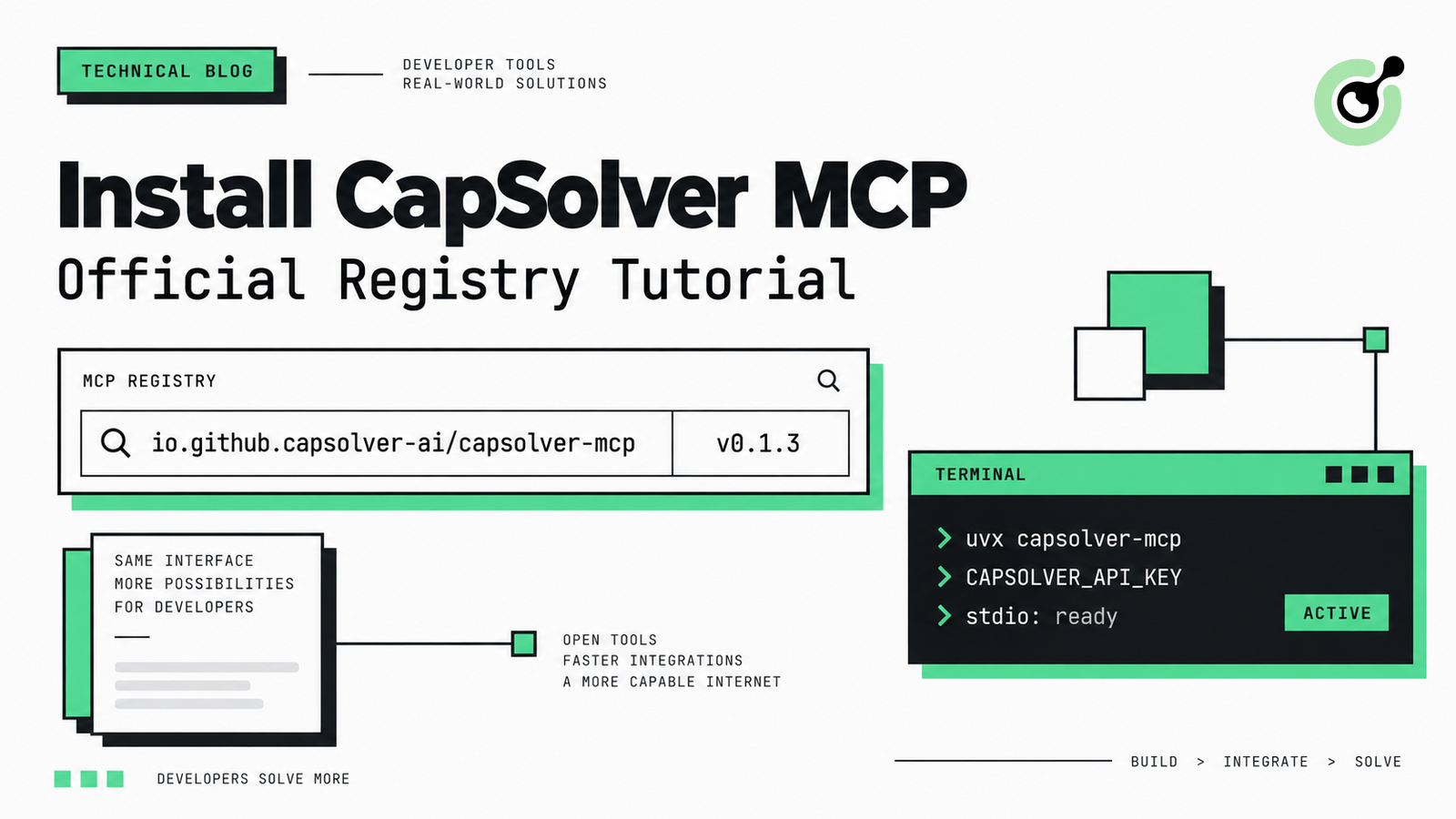
How to Install CapSolver MCP from the Official MCP Registry
Find CapSolver MCP in the Official MCP Registry, install version 0.1.3 with uvx or pip, configure a local client, and verify the stdio tools.

Khadija Santos
18-Sep-2026
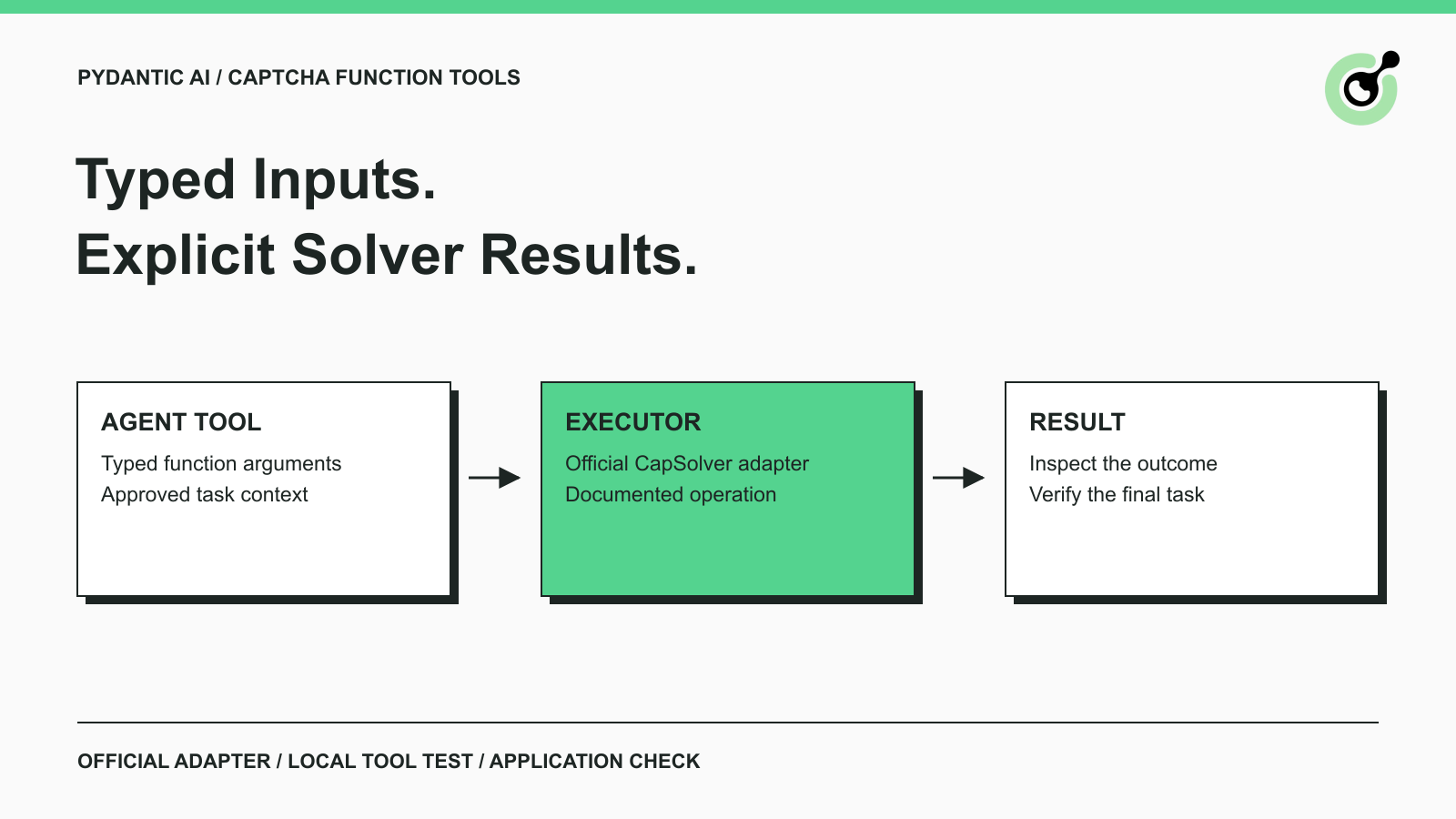
Pydantic AI CAPTCHA Tools: Typed Inputs and Solver Results
Add CAPTCHA tools to Pydantic AI using the official CapSolver adapter, test tool execution locally, and handle typed inputs and structured solver results.
Khadija Santos
18-Sep-2026
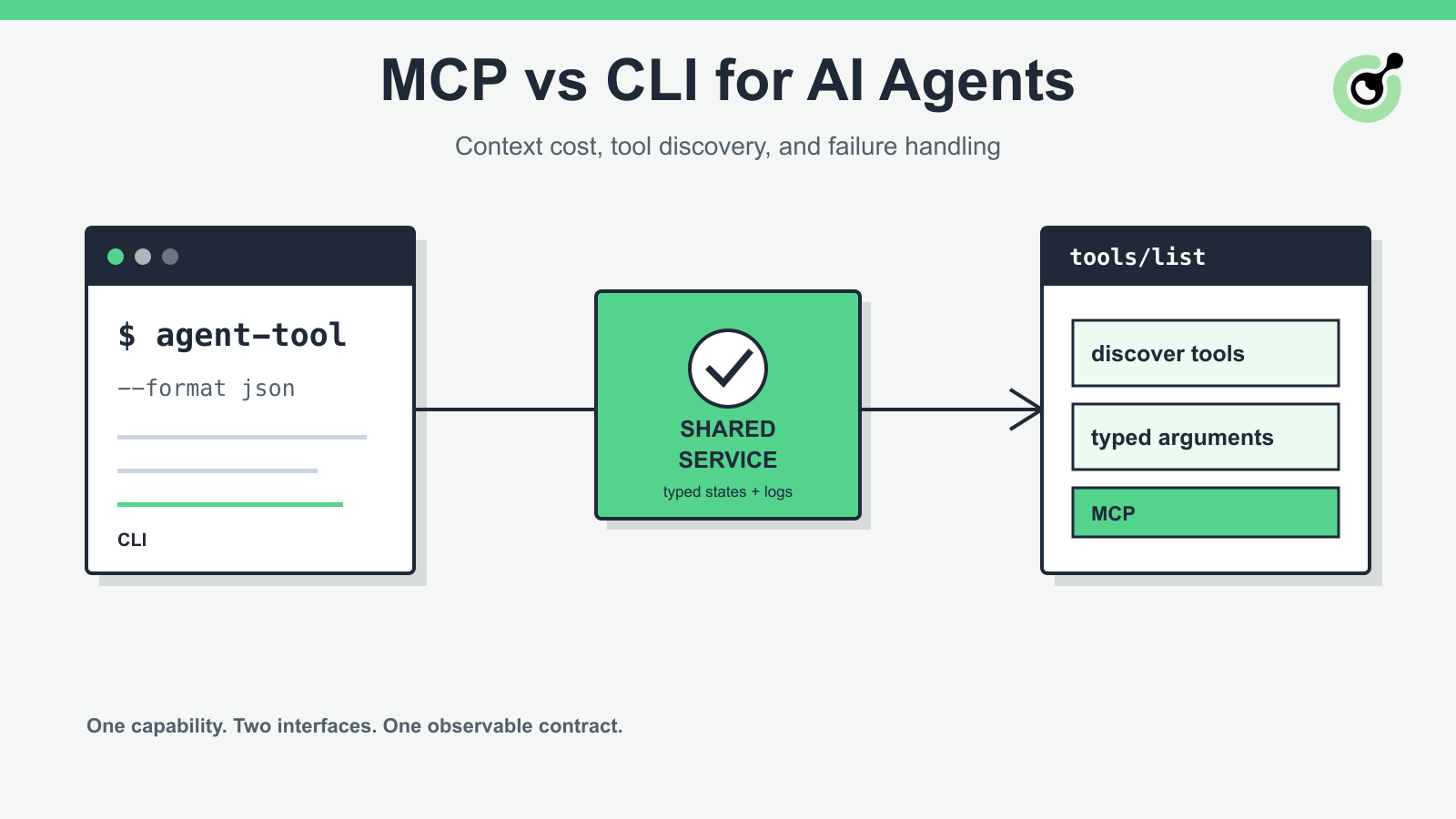
MCP vs CLI for AI Agents: Context Cost and Failure Handling
Compare MCP and CLI interfaces for AI agents across tool discovery, context cost, security, debugging, failure handling, and hybrid architecture.

Nikolai Smirnov
18-Sep-2026
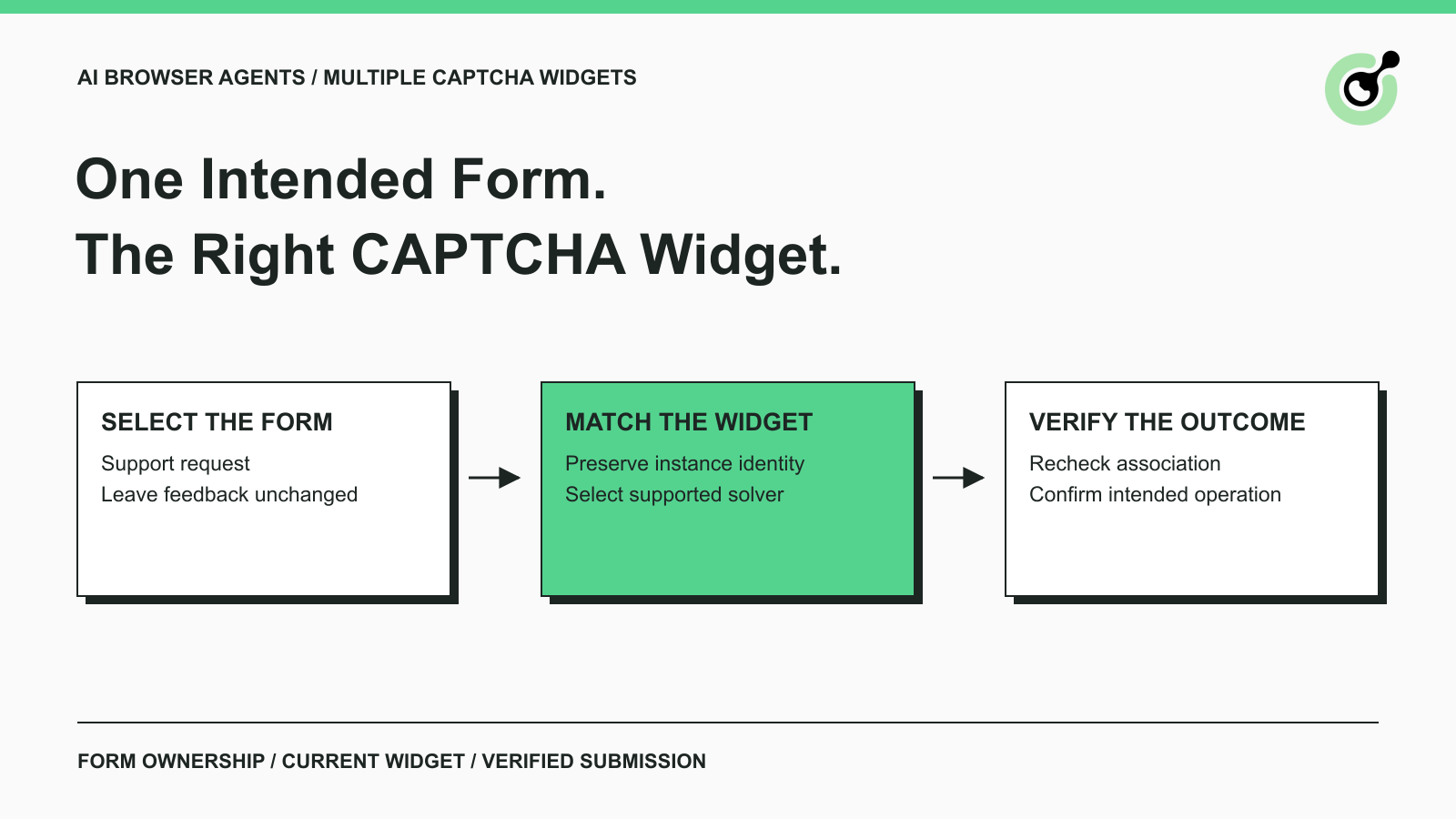
How to Handle Multiple CAPTCHA Widgets in AI Browser Agents
Handle multiple CAPTCHA widgets on one page with explicit form ownership, solver parameters, result routing, and checks for the intended AI agent action.
Lucas Mitchell
15-Sep-2026

CapSolver MCP Server Is Now Available for AI Agents
Install CapSolver MCP Server from PyPI and give compatible AI agents five tools for authorized CAPTCHA handling through the Model Context Protocol.

Sora Fujimoto
11-Sep-2026

AI Agents vs Scripts: How to Choose for Web Automation
Choose between AI agents, scripts, and hybrid web automation by task uncertainty, testability, cost, and the controls needed for reliable execution.
Lucas Mitchell
11-Sep-2026