











CAPTCHA: The Missing Component in AI Agent Infrastructure

Adélia Cruz
Neural Network Developer
24-Jun-2026
TL;DR
- AI agent infrastructure requires robust mechanisms to handle traffic validation and risk control systems effectively.
- Traditional web automation tools often fail when encountering modern security checkpoints and behavioral analysis.
- Integrating a reliable solving API ensures continuous operation and high success rates for autonomous agents.
- CapSolver provides an agent-ready solution that integrates directly into your existing architecture.
- Proper handling of validation challenges is essential for scalable, reliable, and compliant data collection pipelines.
Introduction
Building robust AI agent infrastructure requires more than just advanced language models and execution environments. The most significant hurdle for autonomous agents operating on the web is navigating complex traffic validation systems. When agents encounter these challenges, operations halt, data collection fails, and the entire workflow breaks down. Integrating a reliable solution like CapSolver is essential for maintaining continuous execution. Modern web environments deploy sophisticated risk control mechanisms designed to differentiate human users from automated scripts. Without a dedicated component to handle these challenges, your AI agent infrastructure remains incomplete and fragile. This article explores why addressing traffic validation is critical for autonomous systems and how to implement effective solutions that ensure reliable, compliant, and scalable operations across diverse web platforms.
The Evolution of AI Agent Infrastructure
The development of autonomous agents has shifted from simple script execution to complex, goal-oriented behavior. Early automation relied on basic HTTP requests and static HTML parsing. These methods were sufficient for early web applications but quickly became obsolete as the internet evolved. Today, AI agent infrastructure incorporates headless browsers, computer vision, and dynamic decision-making capabilities. This evolution allows agents to interact with modern, JavaScript-heavy web applications just like human users.
However, as agents become more sophisticated, so do the systems designed to manage automated traffic. Web platforms implement multi-layered risk control measures to protect their resources and maintain service quality. These measures include behavioral analysis, device fingerprinting, and complex validation challenges. For an agent to function effectively, the underlying AI agent infrastructure must account for these security layers. Ignoring this requirement leads to high failure rates and unreliable performance in production environments.
To understand the scope of this issue, we must examine the components that make up a modern automation stack. A typical setup includes a language model for reasoning, a memory system for context retention, and an execution environment for interacting with external interfaces. While developers focus heavily on reasoning and memory, the execution environment often lacks the necessary tools to handle traffic validation. This gap in the AI agent infrastructure is where most autonomous systems fail in real-world applications. Bridging this gap requires a fundamental shift in how we design and deploy automated systems.
Understanding Modern Traffic Validation Mechanisms
Modern web platforms employ a variety of techniques to identify and manage automated traffic. These systems go far beyond simple IP rate limiting. They analyze hundreds of data points to build a comprehensive profile of the visitor. Understanding these mechanisms is crucial for building resilient automation architecture.
One of the primary methods is browser fingerprinting. This technique collects information about the user's operating system, browser version, installed fonts, screen resolution, and hardware concurrency. If the fingerprint matches known automation tools or lacks the typical entropy of a human user, the system flags the request. Additionally, platforms monitor behavioral patterns such as mouse movements, keystroke dynamics, and navigation speed. Automated scripts often exhibit rigid, predictable patterns that are easily distinguishable from human behavior.
When a system detects anomalies in the fingerprint or behavior, it typically presents a validation challenge. These challenges require cognitive processing that is difficult for standard scripts to replicate. They may involve identifying objects in images, transcribing distorted text, or solving logical puzzles. For an autonomous agent, encountering one of these challenges without a dedicated solving mechanism results in an immediate failure. Therefore, understanding the bot protection infrastructure for AI agents is a prerequisite for developing reliable automation workflows.
The OWASP Automated Threats to Web Applications project provides detailed documentation on how platforms identify and mitigate automated interactions, highlighting the complexity of modern risk control systems.
Why Traffic Validation Disrupts Autonomous Agents
When an autonomous agent navigates to a target website, it often encounters a traffic validation checkpoint. These checkpoints evaluate the request based on the factors mentioned above. If the system detects anomalies, it presents a challenge.
For a human user, solving a validation challenge is a minor inconvenience. For an automated system, it is a hard blocker. Standard web automation tools cannot interpret or solve these challenges natively. When an agent encounters a checkpoint, it typically times out or returns an error, disrupting the entire workflow. This disruption highlights a critical flaw in many AI agent infrastructure designs: the assumption that web interfaces will always be accessible and responsive.
To build resilient systems, developers must integrate a CAPTCHA solving API for autonomous agents. This integration allows the agent to detect challenges, forward them to a specialized service, and submit the solution without manual intervention. By incorporating this capability into the AI agent infrastructure, developers ensure that their systems can operate continuously, even when faced with aggressive risk control measures.
The inability to handle these checkpoints not only causes immediate task failure but also corrupts the agent's state. If an agent assumes a page has loaded successfully but is actually stuck on a validation screen, subsequent actions will fail, leading to cascading errors. This makes robust error handling and state verification essential components of any automation framework.
According to the W3C Working Group Note on CAPTCHA, automated systems must have accessible alternatives or programmatic interfaces to navigate validation checkpoints effectively, emphasizing the need for structured solutions.
Integrating Solutions into Your Architecture
Adding a solving component to your agent framework requires careful planning. The integration must be reliable, fast, and capable of handling various challenge types. A poorly implemented solution can introduce latency and reduce the overall efficiency of the agent.
The first step is selecting the right service. Developers should look for an agent-ready CAPTCHA solver that offers high accuracy and low response times. The service should support modern challenge types, including image recognition, audio transcription, and behavioral puzzles. Once a service is selected, it must be integrated into the agent's execution loop.
When the agent detects a validation checkpoint, it pauses its primary task and initiates the solving process. The agent extracts the necessary parameters from the page, sends them to the solving API, and waits for the response. Upon receiving the solution, the agent submits it to the target website and resumes its workflow. This process must be handled asynchronously to prevent the agent from blocking other operations.
Error recovery is another critical aspect of integration. If a solution fails or times out, the agent must be capable of retrying the process or escalating the issue. Implementing exponential backoff and fallback strategies ensures that temporary network issues or service degradations do not cause permanent task failures.
Redeem Your CapSolver Bonus Code
Boost your automation budget instantly!
Use bonus code CAP26 when topping up your CapSolver account to get an extra 5% bonus on every recharge — with no limits.
Redeem it now in your CapSolver Dashboard

The Role of Headless Browsers in Automation
Headless browsers are a fundamental component of modern AI agent infrastructure. They allow agents to render JavaScript, interact with dynamic elements, and simulate human behavior. However, headless browsers also introduce unique challenges when dealing with traffic validation.
Many risk control systems specifically target headless browsers by analyzing their execution environment. They check for specific JavaScript variables, browser properties, and rendering inconsistencies. If a headless browser is detected, the system is more likely to present a validation challenge or block the request entirely. Understanding what headless browser detection is and how to avoid it is crucial for maintaining reliable operations.
To mitigate this issue, developers must configure their headless browsers to mimic standard user environments. This involves modifying browser fingerprints, managing cookies, and simulating realistic interaction patterns. Even with these precautions, agents will still encounter validation checkpoints. Therefore, a robust AI agent infrastructure must combine stealthy browser configurations with a reliable solving service.
The MDN Web Docs on WebDriver provide extensive guidelines on how automated browsers interact with web elements, which is essential for configuring stealth environments and managing browser automation protocols effectively.
Comparing Approaches to Traffic Validation
When designing AI agent infrastructure, developers have several options for handling traffic validation. Each approach has its advantages and limitations. The choice depends on the specific requirements of the project, including scale, budget, and technical expertise.
| Approach | Description | Pros | Cons |
|---|---|---|---|
| Manual Intervention | Pausing the agent and alerting a human operator to solve the challenge. | High accuracy, no additional API costs. | Not scalable, introduces significant latency, defeats the purpose of automation. |
| In-House Machine Learning | Developing custom models to solve specific challenge types. | Complete control over the process, potentially lower long-term costs. | Requires significant expertise, high maintenance overhead, struggles with new challenge types. |
| Third-Party API Integration | Using a specialized service to handle challenge resolution. | Highly scalable, supports diverse challenge types, low maintenance. | Requires ongoing subscription or usage fees, introduces external dependency. |
| Hybrid Systems | Combining basic in-house models with third-party APIs for complex challenges. | Balances cost and capability, optimizes resource usage. | Complex to implement and maintain, requires sophisticated routing logic. |
For most enterprise applications, integrating a third-party API is the most practical approach. It allows developers to focus on building the core logic of their automation systems rather than maintaining complex computer vision models. When evaluating options, it is helpful to review the best CAPTCHA API for AI agents in 2026 to ensure you select a service that meets your performance requirements and integration capabilities.
Building Resilient Data Collection Pipelines
Scaling an autonomous system requires a robust web automation infrastructure stack for AI agents. As the volume of requests increases, the frequency of validation challenges will also rise. Your automation architecture must be capable of handling this increased load without degrading performance.
This requires a distributed architecture where agents can operate concurrently across multiple nodes. The solving component must also scale accordingly, supporting high concurrency and rapid response times. Implementing a microservices architecture allows developers to isolate the solving logic from the core agent execution, improving reliability and maintainability.
Furthermore, monitoring and logging are critical for maintaining a healthy AI agent infrastructure. Developers must track success rates, response times, and error frequencies to identify potential issues before they impact operations. By continuously analyzing this data, organizations can optimize their automation stack and ensure consistent performance across all deployments.
Proxy management is another vital element of resilient pipelines. Rotating IP addresses helps distribute requests and reduces the likelihood of triggering rate limits or IP-based blocks. Combining high-quality proxies with effective validation solving creates a highly resilient automation environment.
Compliance and Responsible Automation
As AI agent infrastructure becomes more capable, the importance of responsible automation increases. Agents must operate within legal and ethical boundaries, respecting the terms of service of the platforms they interact with. Traffic validation systems are often implemented to protect user data, prevent fraud, and ensure fair access to resources.
When integrating solving capabilities into your agent framework, it is essential to consider the impact of your operations. Automated systems should not be used to overload servers, scrape sensitive personal information, or engage in malicious activities. Developers must implement rate limiting, respect robots.txt directives, and ensure their agents identify themselves appropriately when required.
The Electronic Frontier Foundation guidelines on innovation emphasize the need for automated systems to respect user privacy and platform integrity while promoting technological advancement.
By adhering to these principles, organizations can build sustainable automation systems that provide value without causing harm. Responsible automation ensures long-term viability and reduces the risk of legal or reputational damage, fostering a healthier ecosystem for both developers and platform operators.
Conclusion
Traffic validation remains a significant hurdle for autonomous systems operating on the modern web. Without a dedicated mechanism to handle these challenges, even the most advanced agents will fail to execute their tasks reliably. By integrating a robust solving component into your AI agent infrastructure, you ensure continuous operation, scalability, and efficiency. Addressing this missing component transforms fragile scripts into resilient, enterprise-grade automation systems. For developers looking to enhance their architecture, implementing CapSolver provides the necessary capabilities to navigate complex risk control environments effectively and maintain uninterrupted workflows.
FAQ
What is the biggest challenge for autonomous agents on the web?
The most significant challenge is navigating traffic validation and risk control systems, which often block automated requests and disrupt workflows.
How do headless browsers affect traffic validation?
Headless browsers can trigger validation checkpoints if they do not accurately simulate human interaction patterns or if their execution environment is detected by risk control systems.
Why is manual intervention not suitable for AI agents?
Manual intervention introduces significant latency and prevents the system from scaling, fundamentally undermining the purpose of autonomous automation.
What should developers look for in a solving API?
Developers should prioritize high accuracy, low response times, support for diverse challenge types, and the ability to handle concurrent requests at scale.
How can organizations ensure responsible automation?
Organizations must implement rate limiting, respect platform guidelines, avoid scraping sensitive data, and ensure their automated systems do not overload target servers.
Compliance Disclaimer: The information provided on this blog is for informational purposes only. CapSolver is committed to compliance with all applicable laws and regulations. The use of the CapSolver network for illegal, fraudulent, or abusive activities is strictly prohibited and will be investigated. Our captcha-solving solutions enhance user experience while ensuring 100% compliance in helping solve captcha difficulties during public data crawling. We encourage responsible use of our services. For more information, please visit our Terms of Service and Privacy Policy.
More
How to Solve CAPTCHA with TinyFish AgentQL – Step-by-Step Guide Using CapSolver
Learn how to integrate CapSolver with TinyFish AgentQL to automatically solve CAPTCHAs like reCAPTCHA and Cloudflare Turnstile. Step-by-step tutorial with Python and JavaScript SDK examples for seamless AI-powered web automation.

Ethan Collins
05-Aug-2026
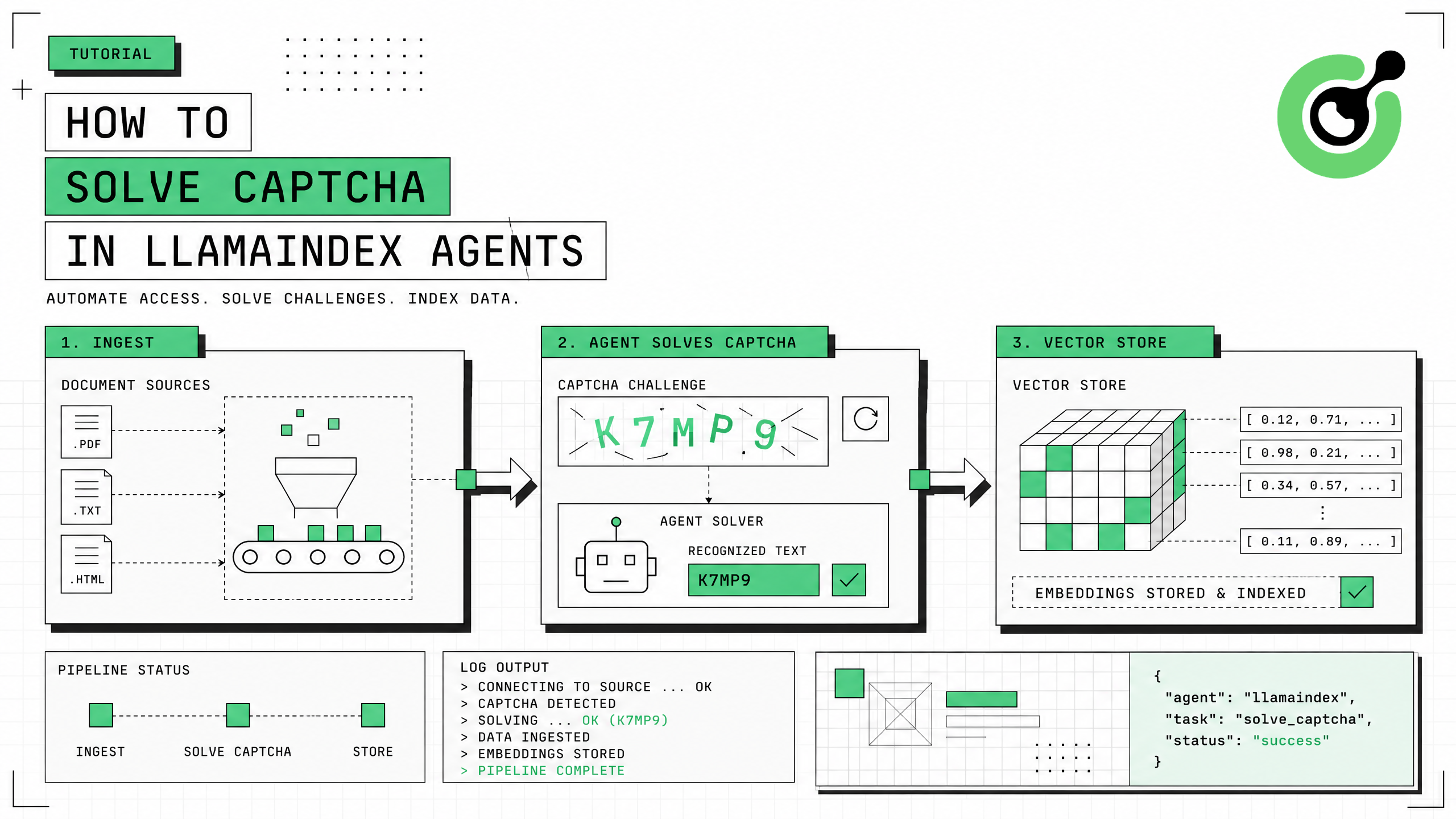
How to Solve CAPTCHA in LlamaIndex Agents
Integrate CAPTCHA solving into LlamaIndex agents using FunctionTool and CapSolver for web data ingestion pipelines.
Ethan Collins
31-Jul-2026
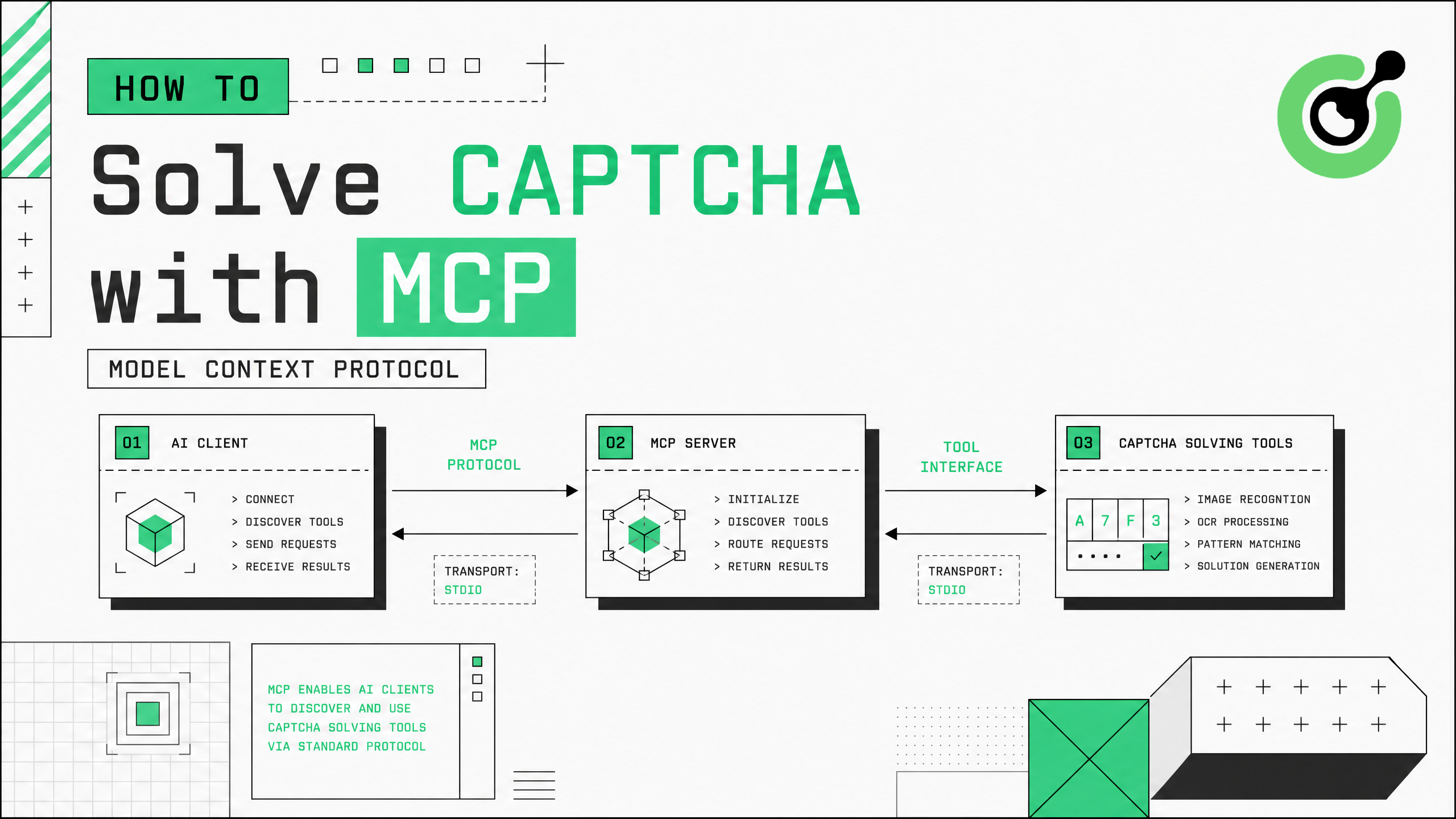
How to Solve CAPTCHA with MCP: CapSolver Model Context Protocol Service
Set up CapSolver MCP service for zero-code CAPTCHA solving in Claude Desktop, Cursor, and any MCP client.
Ethan Collins
31-Jul-2026
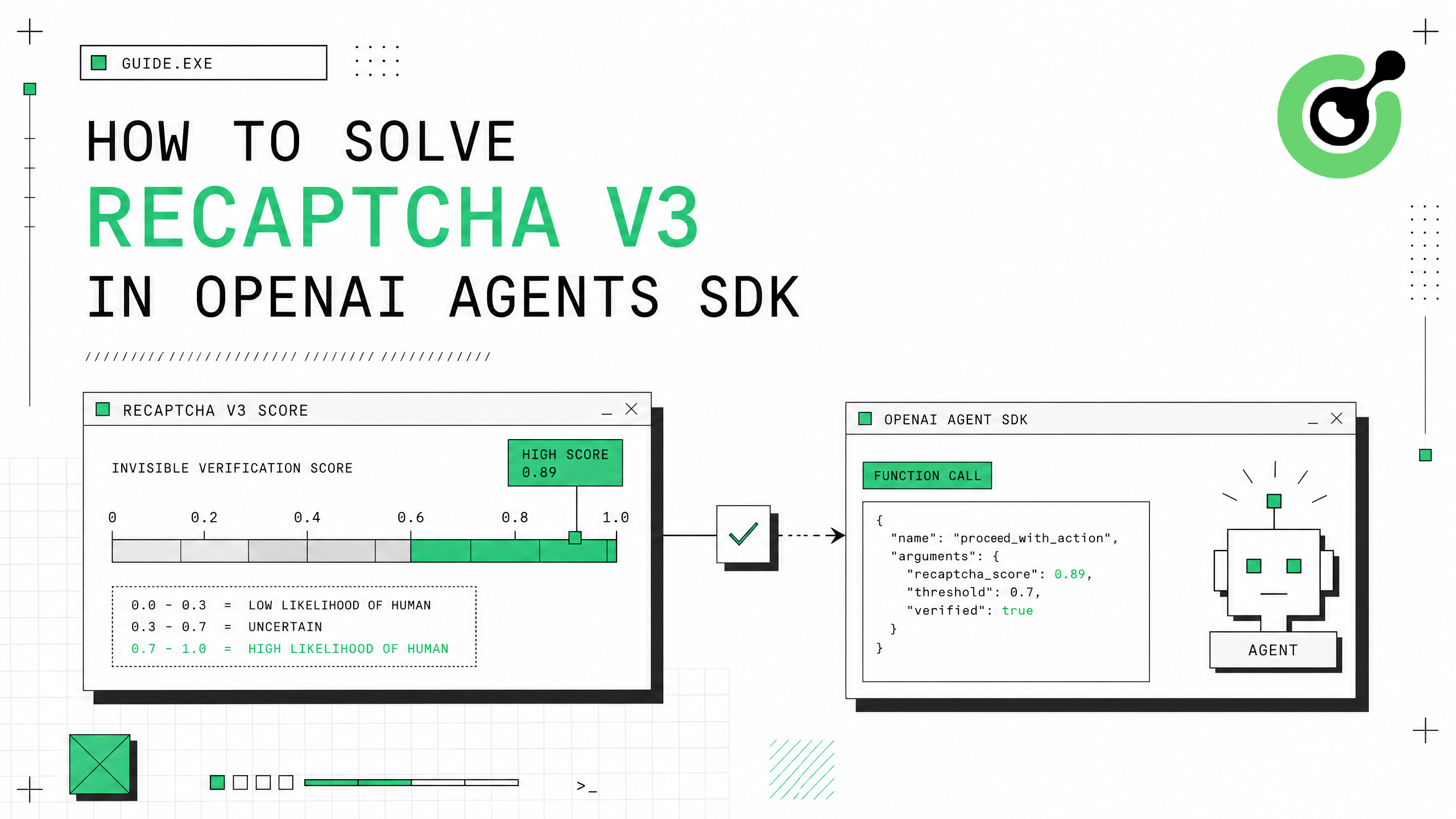
How to Solve reCAPTCHA v3 in OpenAI Agents SDK
Generate high-score reCAPTCHA v3 tokens in OpenAI Agents SDK using CapSolver function_tool.
Ethan Collins
30-Jul-2026
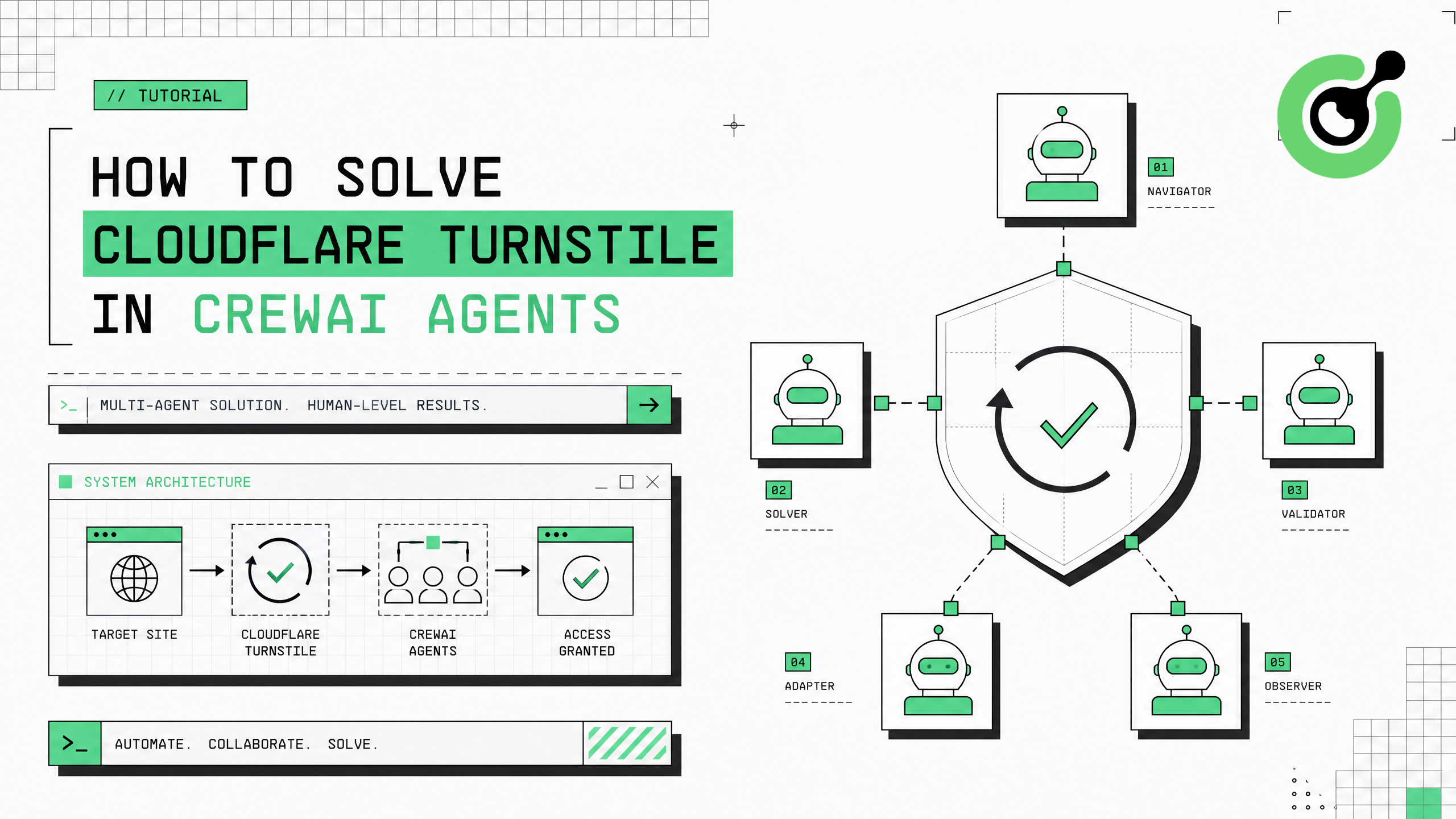
How to Solve Cloudflare Turnstile in CrewAI Agents
Integrate Cloudflare Turnstile solving into CrewAI multi-agent workflows using CapSolver.
Ethan Collins
30-Jul-2026
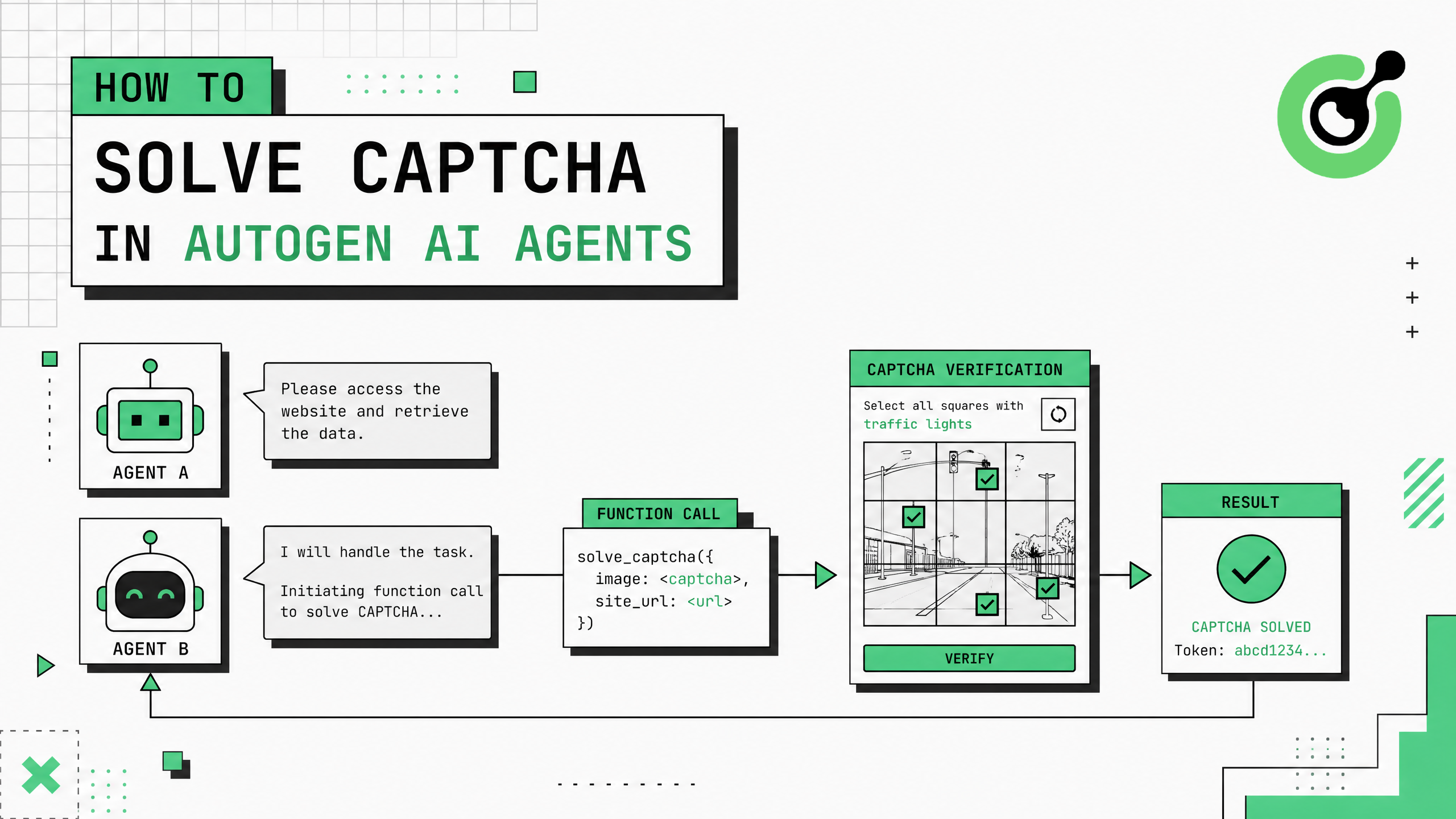
How to Solve CAPTCHA in AutoGen Agents
Complete guide to integrating CAPTCHA solving into Microsoft AutoGen multi-agent conversations using CapSolver with register_function and group chat patterns.
Ethan Collins
29-Jul-2026