











How to Solve CAPTCHA in AutoGen Agents

Ethan Collins
Pattern Recognition Specialist
29-Jul-2026
Microsoft's AutoGen framework enables conversational AI agents that collaborate through multi-turn dialogue to complete complex tasks. When AutoGen agents perform web-based operations — data retrieval, form submission, or automated research — CAPTCHA challenges interrupt the conversation flow and block task completion. CapSolver's capsolver-agent package provides tool schemas and an async executor that integrate directly into AutoGen's function-calling mechanism, giving your agents the ability to clear reCAPTCHA, Cloudflare Turnstile, and other verification challenges mid-conversation.
TL;DR
- AutoGen's conversational agents stall when web tasks encounter CAPTCHA verification challenges
- CapSolver integrates through AutoGen's
register_functionAPI as a callable tool - The
capsolver-agentexecutor handles solving asynchronously and returns structured results - Supports reCAPTCHA v2/v3 (including Enterprise) and Cloudflare Turnstile
- Works with both AutoGen's two-agent chat and group chat patterns
Why AutoGen Agents Need CAPTCHA Solving
AutoGen's multi-agent architecture uses conversational patterns where agents collaborate through messages. A typical setup includes an AssistantAgent (the AI) and a UserProxyAgent (that executes code and tools). When the assistant determines that a web task requires CAPTCHA solving, it needs a registered function to call — otherwise the conversation loop stalls with no way to proceed.
The problem is amplified in AutoGen's group chat scenarios. Multiple agents may need web access simultaneously: one agent researching company data, another verifying contact information, a third checking regulatory filings. Each may encounter CAPTCHAs on different sites. Without a solving mechanism, the entire group conversation halts at the first verification wall.
According to CapSolver's production data, approximately 30% of agent web tasks encounter verification challenges. For an AutoGen workflow executing 10 web-dependent steps, that means 3 potential interruptions per conversation — each requiring either human intervention or an automated solving tool.
What You Need Before Starting
Install required packages:
bash
# CapSolver core engine (required dependency)
pip install git+https://github.com/capsolver-ai/capsolver-core.git

# CapSolver agent tools
pip install git+https://github.com/capsolver-ai/capsolver-agent.git

# AutoGen framework
pip install autogen-agentchat
Set environment variables:
bash
export CAPSOLVER_API_KEY="your-capsolver-api-key"
export OPENAI_API_KEY="your-openai-api-key"
You need a CapSolver account with API credits loaded.
Step 1 — Register CAPTCHA Solving as an AutoGen Function
What to Do
AutoGen uses register_function to make tools available to agents. Create a CAPTCHA solving function and register it:
python
import asyncio
from autogen import AssistantAgent, UserProxyAgent, config_list_from_json
from capsolver_agent.schema import create_executor

# Create the CapSolver executor
executor = create_executor(api_key="YOUR_CAPSOLVER_API_KEY")

def solve_captcha(
    captcha_type: str,
    website_url: str,
    website_key: str,
    page_action: str = "",
    min_score: float = 0.7
) -> str:
    """Solve a CAPTCHA challenge and return the verification token.

    Args:
        captcha_type: The CAPTCHA type - 'reCaptchaV2', 'reCaptchaV3', or 'cloudflare'
        website_url: The full URL of the page with the CAPTCHA
        website_key: The site key (data-sitekey attribute)
        page_action: Action name for reCAPTCHA v3 (optional)
        min_score: Minimum score for reCAPTCHA v3 (default 0.7)

    Returns:
        The solved CAPTCHA token or error message
    """
    params = {
        "captcha_type": captcha_type,
        "website_url": website_url,
        "website_key": website_key
    }
    if page_action and captcha_type == "reCaptchaV3":
        params["page_action"] = page_action
        params["min_score"] = min_score

    result = asyncio.run(executor.execute("solve_captcha", params))

    if result["success"]:
        token = result["solution"]["token"]
        return f"CAPTCHA solved successfully. Token (first 80 chars): {token[:80]}..."
    return f"CAPTCHA solving failed: {result['error']}"
Why This Matters
AutoGen's function registration is the standard way to give agents executable capabilities. The assistant agent sees the function description, understands its parameters through the docstring, and calls it when the conversation requires CAPTCHA solving. This follows AutoGen's design pattern exactly.
Step 2 — Set Up the AutoGen Two-Agent Chat
What to Do
Create an AssistantAgent and UserProxyAgent pair with CAPTCHA solving capability:
python
# LLM configuration
llm_config = {
    "config_list": [{"model": "gpt-4o", "api_key": "YOUR_OPENAI_KEY"}],
    "temperature": 0
}

# Assistant agent (the AI that decides what to do)
assistant = AssistantAgent(
    name="web_assistant",
    system_message="""You are a web research assistant with CAPTCHA solving capability.
    When a task requires accessing a CAPTCHA-protected website, use the solve_captcha
    function with the appropriate parameters:
    - captcha_type: 'reCaptchaV2', 'reCaptchaV3', or 'cloudflare'
    - website_url: the full page URL
    - website_key: the site key from the page

    After solving, return the token to the user for form submission.""",
    llm_config=llm_config
)

# User proxy (executes functions on behalf of the assistant)
user_proxy = UserProxyAgent(
    name="user_proxy",
    human_input_mode="NEVER",
    max_consecutive_auto_reply=5,
    code_execution_config={"work_dir": "workspace", "use_docker": False}
)

# Register the CAPTCHA solving function
from autogen import register_function

register_function(
    solve_captcha,
    caller=assistant,      # The assistant decides when to call
    executor=user_proxy,   # The user proxy executes the function
    name="solve_captcha",
    description="Solve a CAPTCHA challenge (reCAPTCHA v2/v3 or Cloudflare Turnstile) and return the verification token"
)
Why This Matters
The two-agent pattern is AutoGen's core architecture. The assistant reasons about the task and decides to call solve_captcha when needed. The user proxy executes the function call and returns the result to the assistant, which then continues the conversation with the token available.
Step 3 — Run a CAPTCHA-Solving Conversation
What to Do
Initiate a conversation that requires CAPTCHA solving:
python
# Start the conversation
user_proxy.initiate_chat(
    assistant,
    message="""I need to access a page protected by reCAPTCHA v2.
    URL: https://example.com/data-portal
    Site key: 6LeIxAcTAAAAAJcZVRqyHh71UMIEGNQ_MXjiZKhI

    Please solve the CAPTCHA and provide me with the token."""
)
The conversation flow:
- User proxy sends the task message
- Assistant recognizes CAPTCHA solving is needed
- Assistant calls
solve_captchawith the parameters - User proxy executes the function (CapSolver solves it)
- Result returns to assistant
- Assistant presents the token to complete the task
Step 4 — Use in AutoGen Group Chat
What to Do
For complex workflows with multiple agents, register CAPTCHA solving in a group chat:
python
from autogen import GroupChat, GroupChatManager

# Specialized agents
researcher = AssistantAgent(
    name="researcher",
    system_message="You research websites and collect data. Use solve_captcha when you encounter verification challenges.",
    llm_config=llm_config
)

analyst = AssistantAgent(
    name="analyst",
    system_message="You analyze collected data and produce insights.",
    llm_config=llm_config
)

executor_agent = UserProxyAgent(
    name="executor",
    human_input_mode="NEVER",
    code_execution_config={"work_dir": "workspace", "use_docker": False}
)

# Register CAPTCHA solving for the researcher
register_function(
    solve_captcha,
    caller=researcher,
    executor=executor_agent,
    name="solve_captcha",
    description="Solve CAPTCHA challenges on websites"
)

# Create group chat
group_chat = GroupChat(
    agents=[researcher, analyst, executor_agent],
    messages=[],
    max_round=10
)

manager = GroupChatManager(groupchat=group_chat, llm_config=llm_config)

# Start group research task
executor_agent.initiate_chat(
    manager,
    message="Research the data at https://example.com/reports. It's protected by reCAPTCHA v2 (key: 6Le...). Solve the CAPTCHA, collect the data, then analyze it."
)| CAPTCHA Type | Task Type Parameter | Avg Solve Time | Common Sites |
|---|---|---|---|
| reCAPTCHA v2 | reCaptchaV2 |
5-12 seconds | Login pages, forms, portals |
| reCAPTCHA v3 | reCaptchaV3 |
3-8 seconds | APIs, invisible protection |
| Cloudflare Turnstile | cloudflare |
2-5 seconds | Modern SaaS, Shopify sites |
The CapSolver reCAPTCHA guide and Cloudflare Turnstile documentation provide additional parameter details for each CAPTCHA type.
Claim Your Bonus Code: Use code WEBS at CapSolver Dashboard to get an extra 5% bonus on every recharge. Perfect for teams running AutoGen multi-agent workflows.
Step 5 — Production Patterns and Error Handling
What to Do
Add retry logic and balance checking for production deployments:
python
def solve_captcha_with_retry(
    captcha_type: str,
    website_url: str,
    website_key: str,
    max_retries: int = 3
) -> str:
    """Solve CAPTCHA with automatic retry on failure."""
    for attempt in range(max_retries):
        params = {
            "captcha_type": captcha_type,
            "website_url": website_url,
            "website_key": website_key
        }
        result = asyncio.run(executor.execute("solve_captcha", params))

        if result["success"]:
            return f"Solved (attempt {attempt+1}). Token: {result['solution']['token'][:80]}..."

        if attempt < max_retries - 1:
            import time
            time.sleep(3)

    return f"Failed after {max_retries} attempts: {result.get('error', 'Unknown')}"

def check_captcha_balance() -> str:
    """Check remaining CAPTCHA solving credits."""
    result = asyncio.run(executor.execute("get_balance", {}))
    if result["success"]:
        return f"CapSolver balance: ${result['balance']:.2f}"
    return "Could not retrieve balance"
Register both functions for comprehensive capability:
python
register_function(solve_captcha_with_retry, caller=assistant, executor=user_proxy,
    name="solve_captcha", description="Solve CAPTCHA with retry logic")
register_function(check_captcha_balance, caller=assistant, executor=user_proxy,
    name="check_balance", description="Check CAPTCHA solving credit balance")
The CapSolver web scraping documentation covers additional patterns for high-volume data collection applicable to AutoGen research agents. For browser-based automation, the CapSolver extension helps identify CAPTCHA parameters during development.
Conclusion
Integrating CAPTCHA solving into AutoGen agents requires registering a solving function via register_function, connecting it to CapSolver's executor, and letting the assistant agent decide when to invoke it during conversations. CapSolver provides the AI-powered solving infrastructure that clears verification challenges in 3-12 seconds, keeping your AutoGen conversations flowing without human intervention.
Start with the two-agent pattern for simple tasks, then expand to group chat for complex multi-agent workflows. The function registration approach means agents naturally decide when to solve based on conversation context — no hardcoded CAPTCHA detection needed.
FAQ
Does CapSolver work with AutoGen's async execution?
Yes. While AutoGen's register_function uses synchronous function signatures, you can wrap CapSolver's async executor with asyncio.run() inside the registered function. This provides the async solving benefits (connection pooling, concurrent requests) within AutoGen's synchronous function-calling interface.
Can multiple AutoGen agents share the same CAPTCHA solver?
Yes. Register the same solving function with multiple caller agents in a group chat. Each agent can independently invoke CAPTCHA solving when their specific task requires it. CapSolver's API handles concurrent requests without conflicts.
How does AutoGen decide when to call the CAPTCHA solving function?
AutoGen's assistant agent uses the function description and conversation context to decide. When the task mentions accessing a CAPTCHA-protected resource, the assistant recognizes the need and generates a function call with appropriate parameters. You can also include explicit instructions in the system message.
What happens if CAPTCHA solving fails mid-conversation?
The function returns an error message to the assistant agent. The assistant can then retry with different parameters, ask for clarification, or report the failure. AutoGen's conversation loop continues regardless — the failure is handled as part of the dialogue rather than crashing the system.
How much does CAPTCHA solving cost per AutoGen conversation?
A typical AutoGen conversation encountering 1-3 CAPTCHAs costs 0.002-0.009 in solving fees. reCAPTCHA v2 costs approximately 2-3 per 1,000 solves, and Cloudflare Turnstile costs $1-2 per 1,000. For most workflows, CAPTCHA solving cost is negligible compared to LLM API costs.
Compliance Disclaimer: The information provided on this blog is for informational purposes only. CapSolver is committed to compliance with all applicable laws and regulations. The use of the CapSolver network for illegal, fraudulent, or abusive activities is strictly prohibited and will be investigated. Our captcha-solving solutions enhance user experience while ensuring 100% compliance in helping solve captcha difficulties during public data crawling. We encourage responsible use of our services. For more information, please visit our Terms of Service and Privacy Policy.
More
How to Solve CAPTCHA with TinyFish AgentQL – Step-by-Step Guide Using CapSolver
Learn how to integrate CapSolver with TinyFish AgentQL to automatically solve CAPTCHAs like reCAPTCHA and Cloudflare Turnstile. Step-by-step tutorial with Python and JavaScript SDK examples for seamless AI-powered web automation.
Ethan Collins
05-Aug-2026
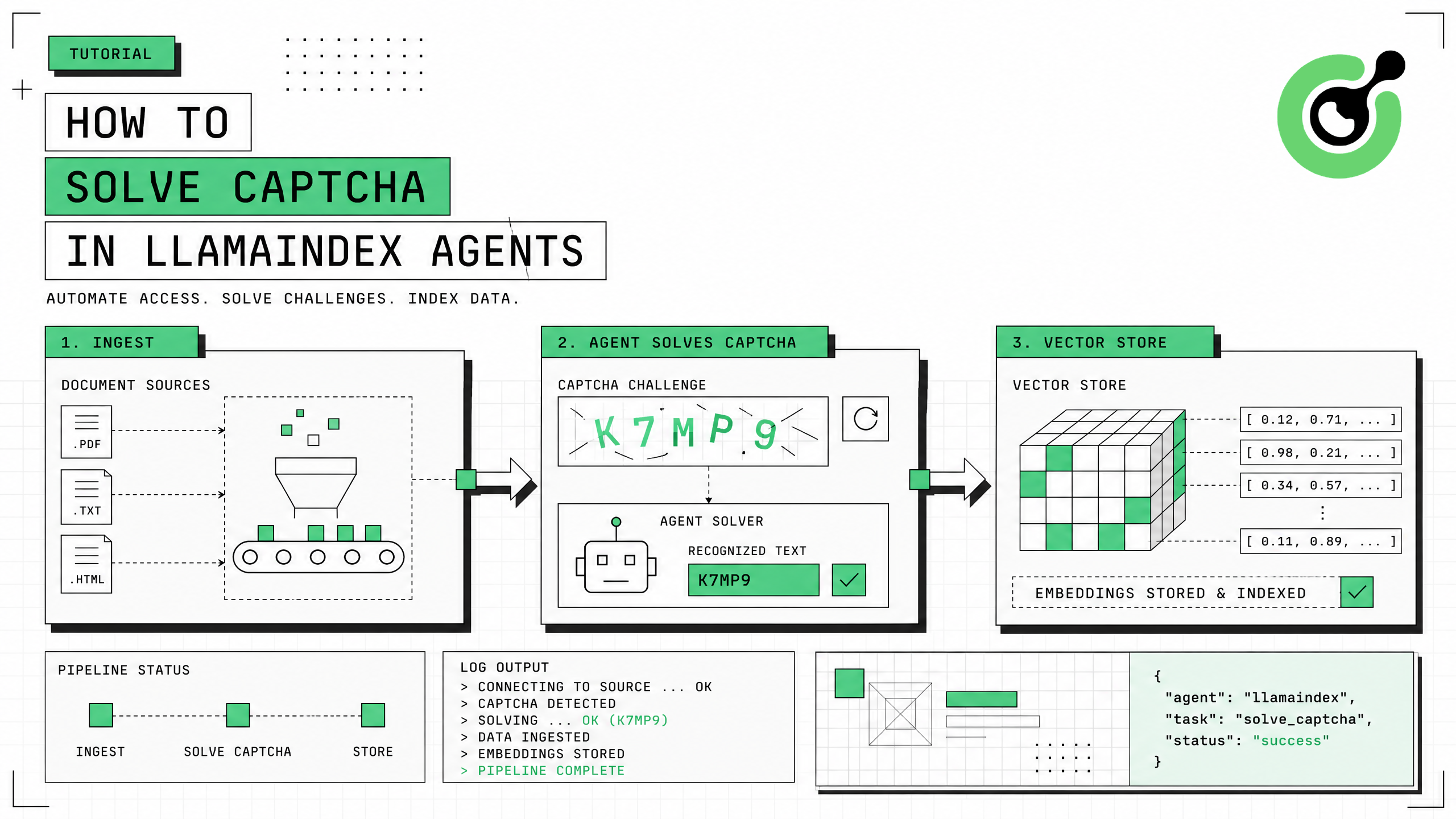
How to Solve CAPTCHA in LlamaIndex Agents
Integrate CAPTCHA solving into LlamaIndex agents using FunctionTool and CapSolver for web data ingestion pipelines.
Ethan Collins
31-Jul-2026
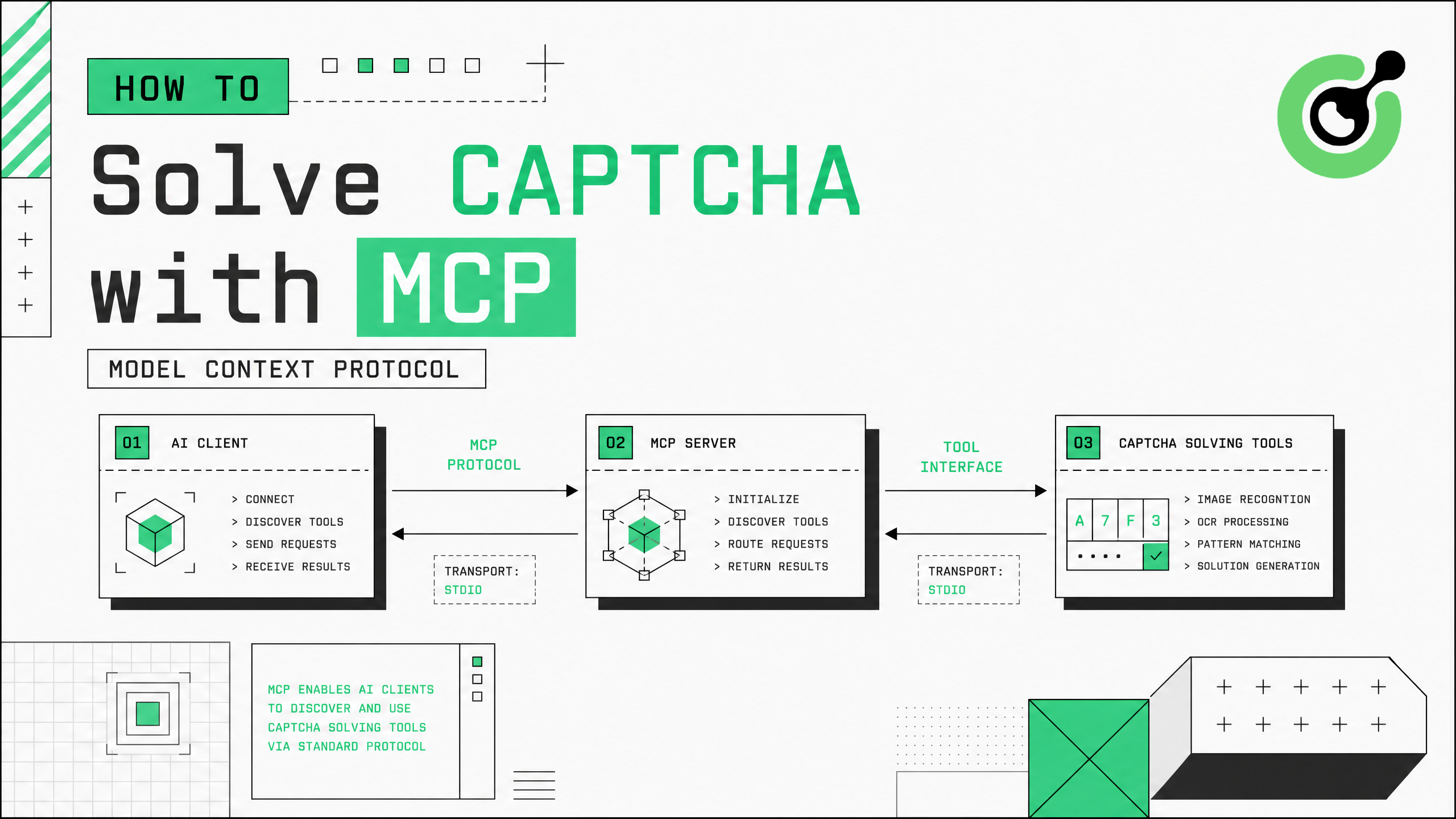
How to Solve CAPTCHA with MCP: CapSolver Model Context Protocol Service
Set up CapSolver MCP service for zero-code CAPTCHA solving in Claude Desktop, Cursor, and any MCP client.
Ethan Collins
31-Jul-2026
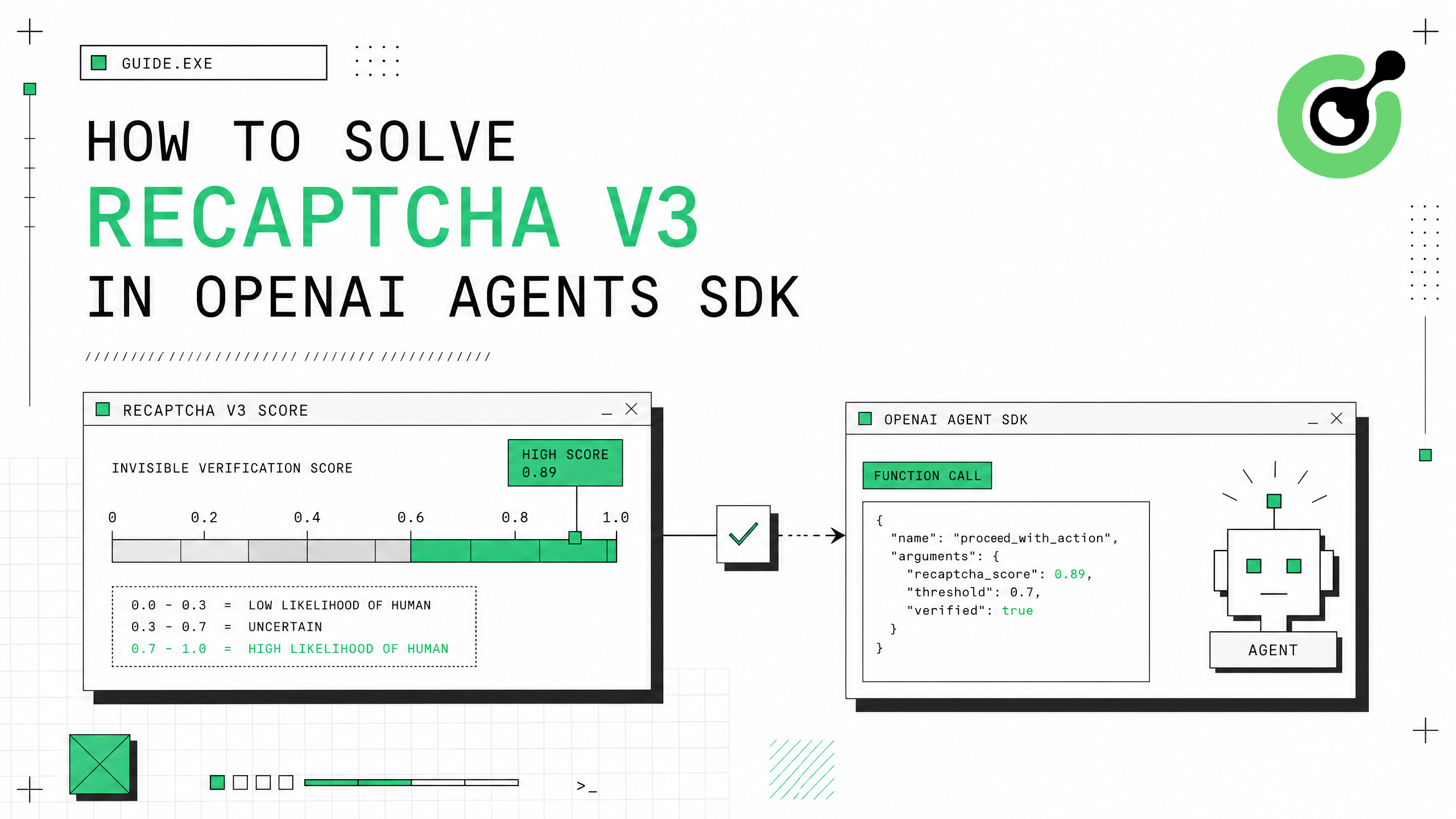
How to Solve reCAPTCHA v3 in OpenAI Agents SDK
Generate high-score reCAPTCHA v3 tokens in OpenAI Agents SDK using CapSolver function_tool.
Ethan Collins
30-Jul-2026
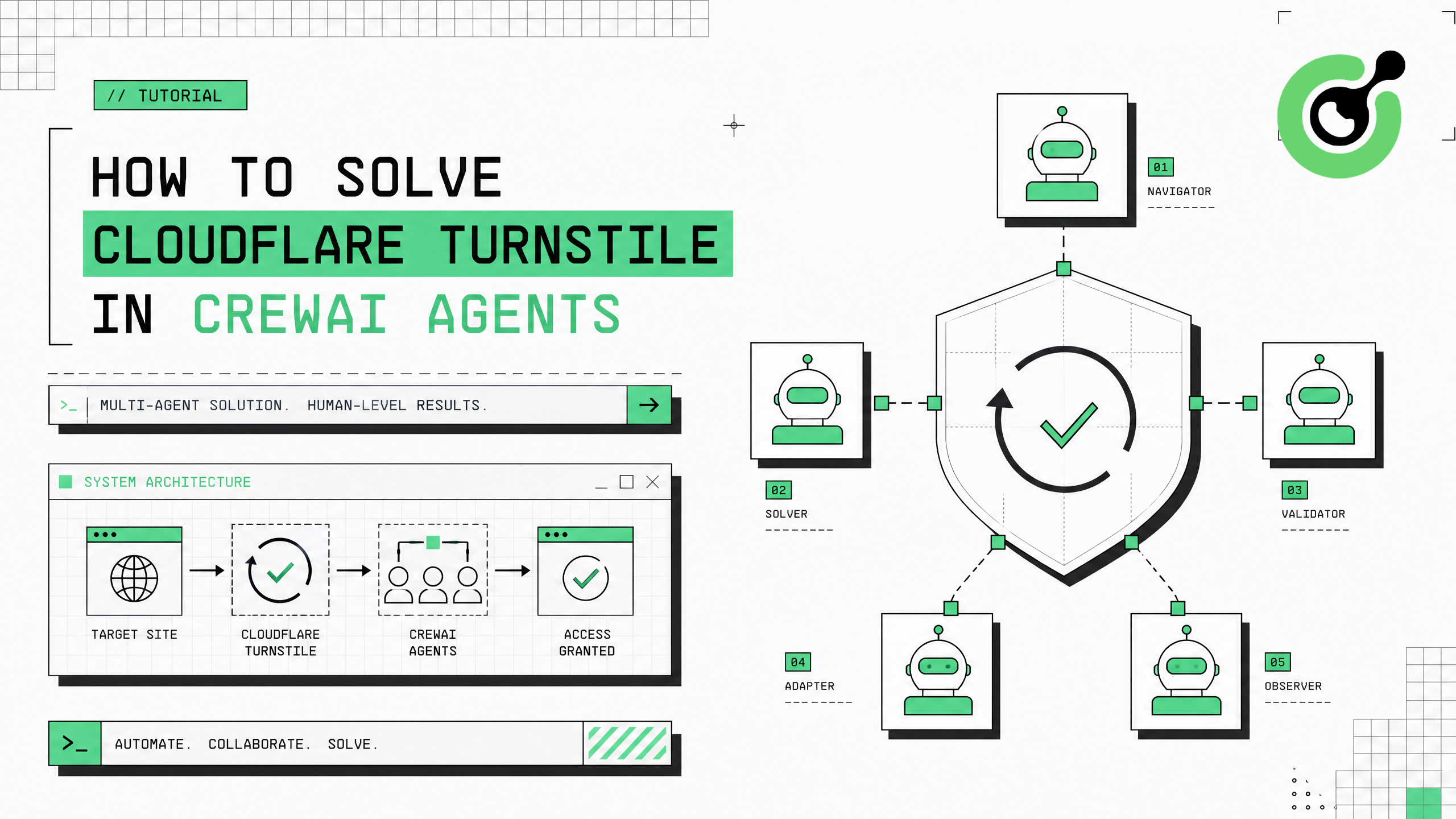
How to Solve Cloudflare Turnstile in CrewAI Agents
Integrate Cloudflare Turnstile solving into CrewAI multi-agent workflows using CapSolver.
Ethan Collins
30-Jul-2026
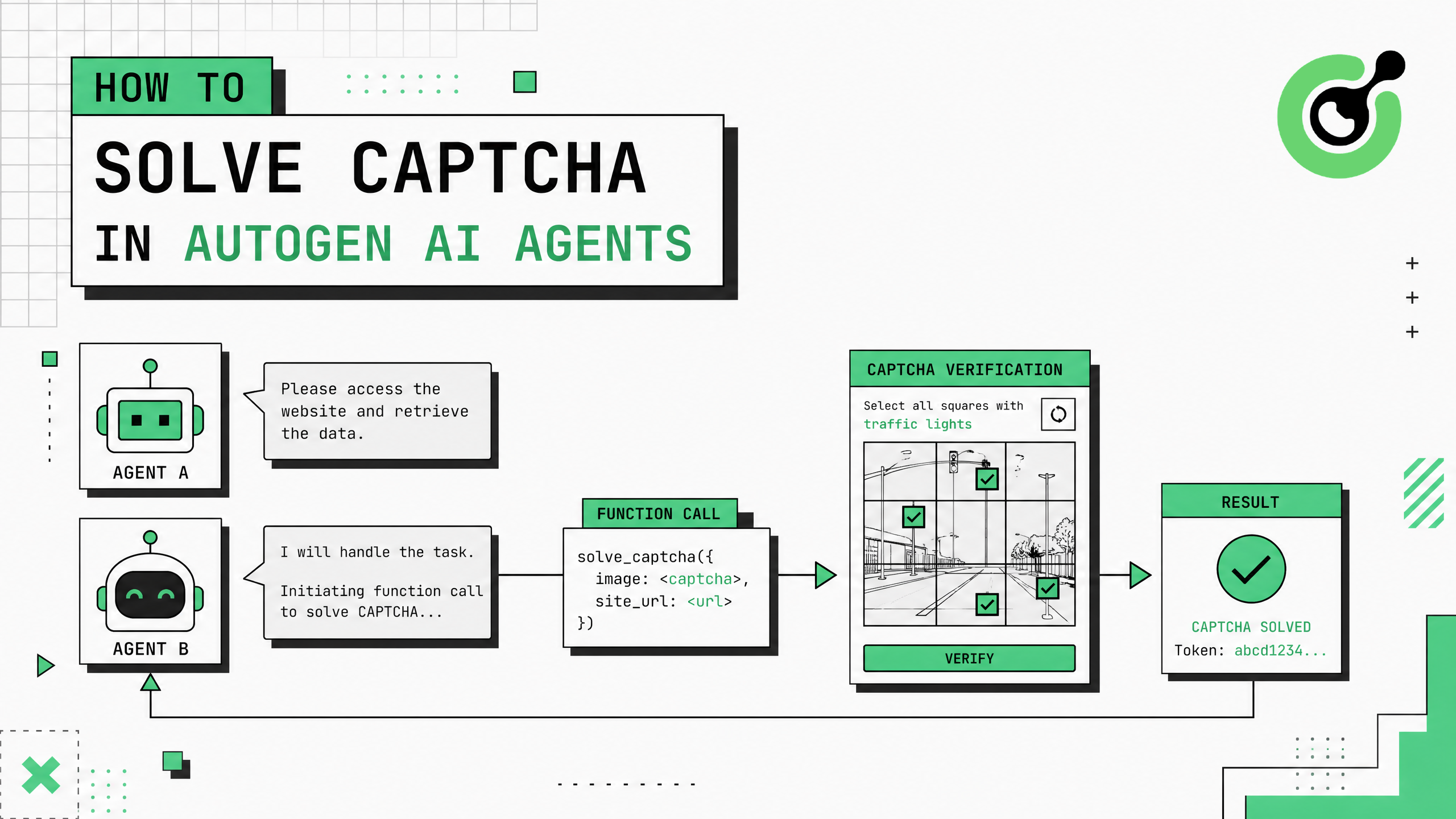
How to Solve CAPTCHA in AutoGen Agents
Complete guide to integrating CAPTCHA solving into Microsoft AutoGen multi-agent conversations using CapSolver with register_function and group chat patterns.
Ethan Collins
29-Jul-2026